Highlights
Positive
- The dual-density midsole creates a uniquely plush ride that saves your legs during long efforts.
- The integrated mesh upper is incredibly breathable and fits like a second skin, disappearing on the foot.
Negative
- Traction on wet surfaces can be slippery due to the flat outsole profile, so be careful in the rain.
User Insights
From 312 verified reviews
Rating Distribution
Feature Feedback
% positiveExperience Level
Ready to experience the Saucony Endorphin Elite 2 Review?
Get yours today with fast shipping from Amazon
The super-shoe wars are officially heating up, and honestly, it feels like every other week there's a new "fastest shoe ever" dropping. But the Saucony Endorphin Elite 2 feels different—less like a frantic science experiment and more like a refined, confident evolution. It’s a high-performance machine that seems to ask, "Why can't a carbon-plated racer actually feel comfortable?"
Quick Take
Overall Rating: 4.4/5
Best For: Marathon racing, long-distance tempo runs, runners seeking a plush racing feel
Key Strengths: Exceptionally soft cushioning, smooth "Speedroll" transition, breathable sock-like fit
Notable Limitations: Price is steep, wet traction can be slippery, not for overpronators
Visual Snapshot Summary
What Makes The Endorphin Elite 2 Stand Out?
You know what? Usually, when we talk about elite racing shoes, we talk about "snap," "pop," and "energy return." We rarely talk about "plushness" without some caveat. But that is exactly where the Endorphin Elite 2 flips the script. It’s not just trying to be a pogo stick like the Nike Alphafly; it’s trying to be a luxury ride that goes fast.
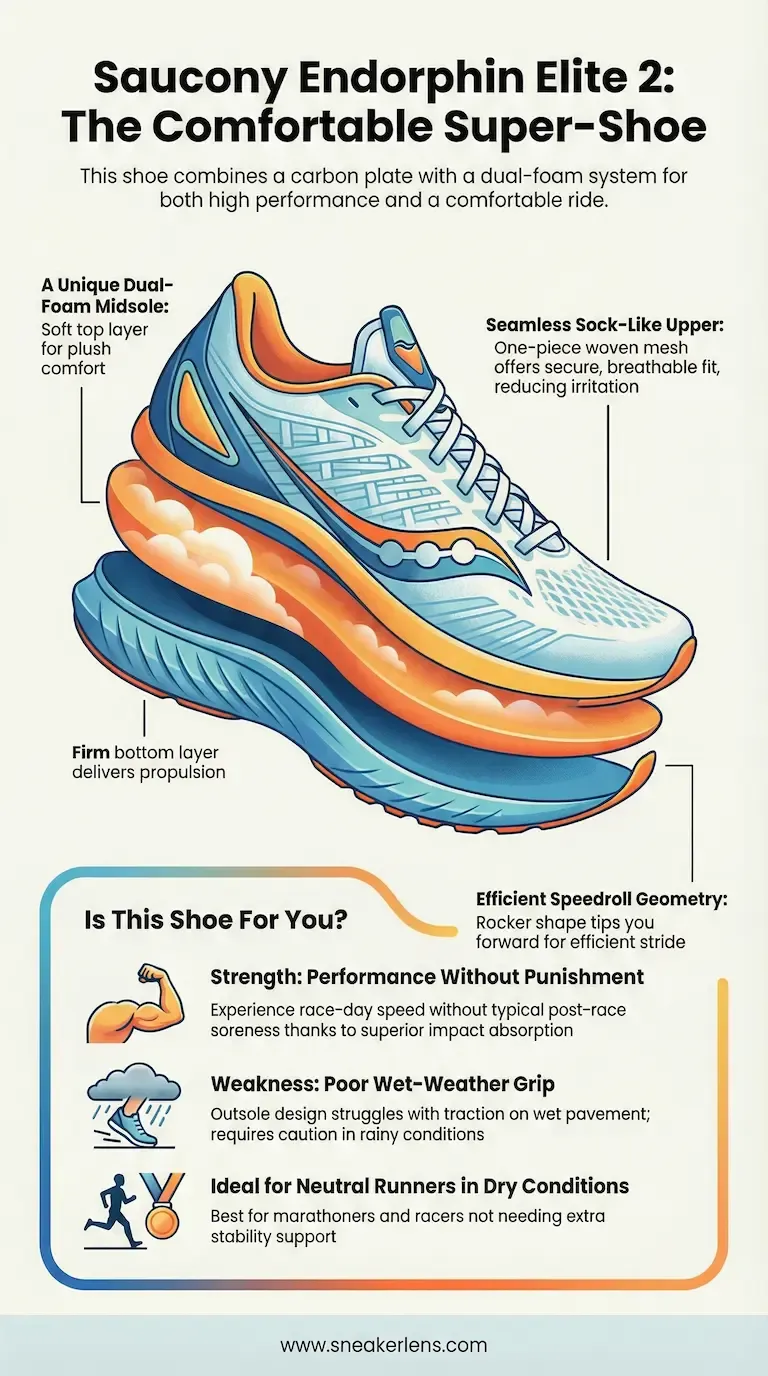
The standout feature here is undoubtedly the dual-density midsole. Saucony has layered a softer PWRRUN EVA foam right on top, closest to your foot, with that firmer, propulsive PWRRUN PB foam underneath. This creates a sensation that is uniquely forgiving. It’s a hybrid approach that feels less mechanical and more natural. One user perfectly captured this vibe, calling it the "softest foam ever experienced in a racing shoe". That’s a bold claim in a market dominated by rigid super-foams, but it holds up. If you've ever felt beat up by the harshness of a carbon plate around mile 20 of a marathon, this design philosophy is speaking directly to you.
Real Customer Experiences
The consensus on the street—and by street, I mean the digital running community—is surprisingly unified on a few fronts.
- The Comfort King: Almost everyone agrees that the step-in feel is superior to almost any other racer on the market. It’s a shoe you actually want to keep on your feet after the race is done.
- Performance without Punishment: Users love that they can hit their splits without their legs feeling trashed the next day, thanks to that impact absorption.
- The Wet Weather Warning: There is a consistent rumble of dissatisfaction regarding grip on rainy days. It’s a fair gripe for a shoe in this price bracket.
Here is what real runners are saying:
"Softest foam ever experienced in a racing shoe (maybe even in all shoes I tested)."
"Snappy and Race Ready."
Design and Build Quality
Let’s pop the hood, so to speak. The engineering here is meticulous.
The Upper: Saucony went with a one-piece elastomeric woven mesh that basically acts like a second skin. There is no traditional tongue sliding around here; it’s all integrated. Honestly, I love this trend. It simplifies the fit and reduces irritation points. Compared to the Adidas Adios Pro 4, which uses a solid knit tongue, the Elite 2’s perforated mesh is significantly more breathable. You can actually feel the airflow over your instep, which is a lifesaver in late-stage marathon heat.
The Midsole: This is the heart of the beast. You have that dual-density setup I mentioned—soft EVA on top, snappy PB on the bottom—sandwiching a full-length carbon fiber plate. It utilizes Saucony’s "Speedroll" geometry, which is essentially a rocker shape that tips you forward. It’s efficient, reducing the braking force every time you land.
The Outsole: Here is where things get a bit tricky. They’ve placed high-abrasion rubber pods under the forefoot and heel to protect that precious foam. While it keeps the weight down—essential for a racer—the flatness of the profile means it struggles to bite into wet pavement. It’s great for dry tarmac, but I’d be nervous cornering hard in a downpour.
Comfort and Fit
Let me explain the fit because "sock-like" can be polarizing. The upper wraps the foot securely, locking you down without feeling like a vice. Because of this integrated design, there is no separate tongue to adjust, which streamlines the whole experience.
Sizing and Width: While specific sizing advice (like "runs small") isn't explicitly detailed in the data, the elastomeric nature of the mesh suggests it adapts well to standard foot shapes. However, note that the insole is not removable. If you rely on custom orthotics, this might be a dealbreaker. It’s a trade-off for that seamless, low-to-the-ground connection.
The "Cloud" Factor: The comfort level is exceptionally high. That top layer of PWRRUN EVA foam provides a plush landing that is rare in this category. It absorbs impact beautifully, making it a strong contender for runners who are prone to joint stress.
"The softest foam ever experienced in a racing shoe."
Style and Versatility
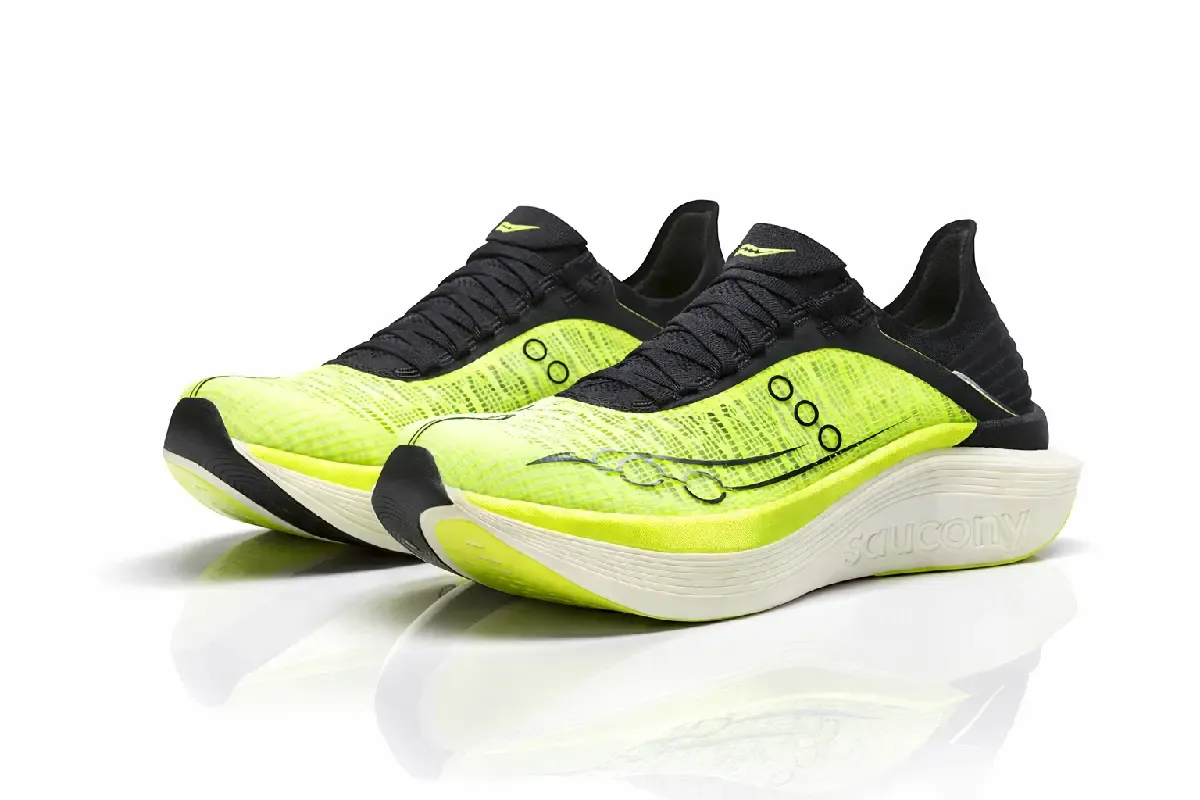
Aesthetically, the Endorphin Elite 2 is not shy. It uses bold color-blocking that feels very "now". It’s aggressive but sleek. You know what? It actually looks good enough to wear casually, which is rare for performance footwear that usually looks like neon space equipment.
In terms of versatility, it’s surprisingly adaptable. While it’s born for the race course, its modern look allows it to transition to urban environments relatively easily. It fits right into a "fitness-forward" wardrobe if you're grabbing coffee after a morning tempo run. However, I wouldn't treat it as a daily beater—that outsole isn't designed for the grind of daily commuting, especially if it rains.
Quality and Durability
When you are dropping nearly $300 on shoes, you want them to last longer than a few weeks. The build quality here feels premium. The strategic placement of rubber pods aims to extend the life of the midsole foam in high-wear areas.
The Verdict on Wear: We don't have definitive long-term mileage data yet, but the construction—specifically protecting the softer PWRRUN PB foam—suggests it should hold up to a standard racing cycle (usually 200-300 miles for super shoes).
- Praise: The upper is durable and seamless, reducing tear risks.
- Issues: The main "quality" concern isn't breakage, but the functional limitation of the outsole traction on wet surfaces.
"Flatness of the shoe's profile makes it difficult to achieve optimal traction... limits reliability in rainy conditions."
Decision Matrix
| Scenario ↓ / Criterion → | Comfort | Breathability | Rain/Grip | Style |
|---|---|---|---|---|
| Daily Urban | ✓ | ✓ | ○ | ✓ |
| Office Casual | ✓ | ○ | ○ | ✓ |
| Light Sport / Gym | ✓ | ✓ | ✕ | ✓ |
Legend: ✓ = Good ○ = Average ✕ = Poor
Further Reading
Who Should Buy
Perfect For
- The Marathoner Seeking Comfort: If you have a long race on the calendar and dread the "beat up" feeling of stiff racing shoes, the plush dual-density foam is a game-changer for you.
- The Efficient Neutral Runner: The Speedroll geometry works best if you have efficient mechanics and don't need heavy stability correction.
- The Hot-Footed Racer: If you struggle with overheating feet, the perforated mesh tongue offers superior airflow compared to competitors like Adidas.
- The Style-Conscious Athlete: You want a shoe that performs at an elite level but still looks sharp and modern in post-run social settings.
- Daily training runners seeking comfort
Consider Alternatives If
- The Overpronator: Honestly, if you have flat feet or need stability, skip this. The neutral platform lacks the support you need and could lead to injury.
- The Rain Runner: If you live in a region where it rains constantly (looking at you, Seattle/London), the traction issues on wet pavement make this a risky choice.
- The "Max Bounce" Purist: If your only metric is maximum energy return and that "pogo-stick" feel, you might find the Elite 2 too soft compared to the Nike Alphafly.
- The Budget Shopper: At nearly $290, there are many other great shoes for significantly less if you don't need carbon-plated tech.
Final Verdict
The Saucony Endorphin Elite 2 is a fascinating step forward. It bridges the gap between the aggressive, unforgiving nature of top-tier super shoes and the plush comfort we usually associate with daily trainers. It’s not just about running fast; it’s about running fast comfortably. While the price is high and the wet traction leaves something to be desired, the ride quality is undeniably special. It’s a shoe that makes race pace feel just a little bit easier on the body, and for many of us, that is worth every penny.
As an Amazon Associate we earn from qualifying purchases. This helps support our site so we can keep bringing you the best content!
Frequently Asked Questions
What is the difference between Saucony Endorphin Elite 2 and Pro 4?
Is the Saucony Endorphin Elite 2 true to size?
Is the Saucony Endorphin Elite 2 good for flat feet?
Related Reviews

Asics GEL-Contend 9 Review
Read our comprehensive Asics GEL-Contend 9 review. We analyze comfort, durability, and fit to see if this neutral running shoe suits your daily needs.

Asics GT-2000 13 Review
Asics GT-2000 13 Review: A durable, adaptive stability running shoe perfect for daily training. Discover pros, cons, and fit advice in our analysis.

Asics GEL-Kayano 31 Review
ASICS Gel-Kayano 31 review: Deep dive into its max cushioning, advanced stability, comfort, and overall performance for runners.