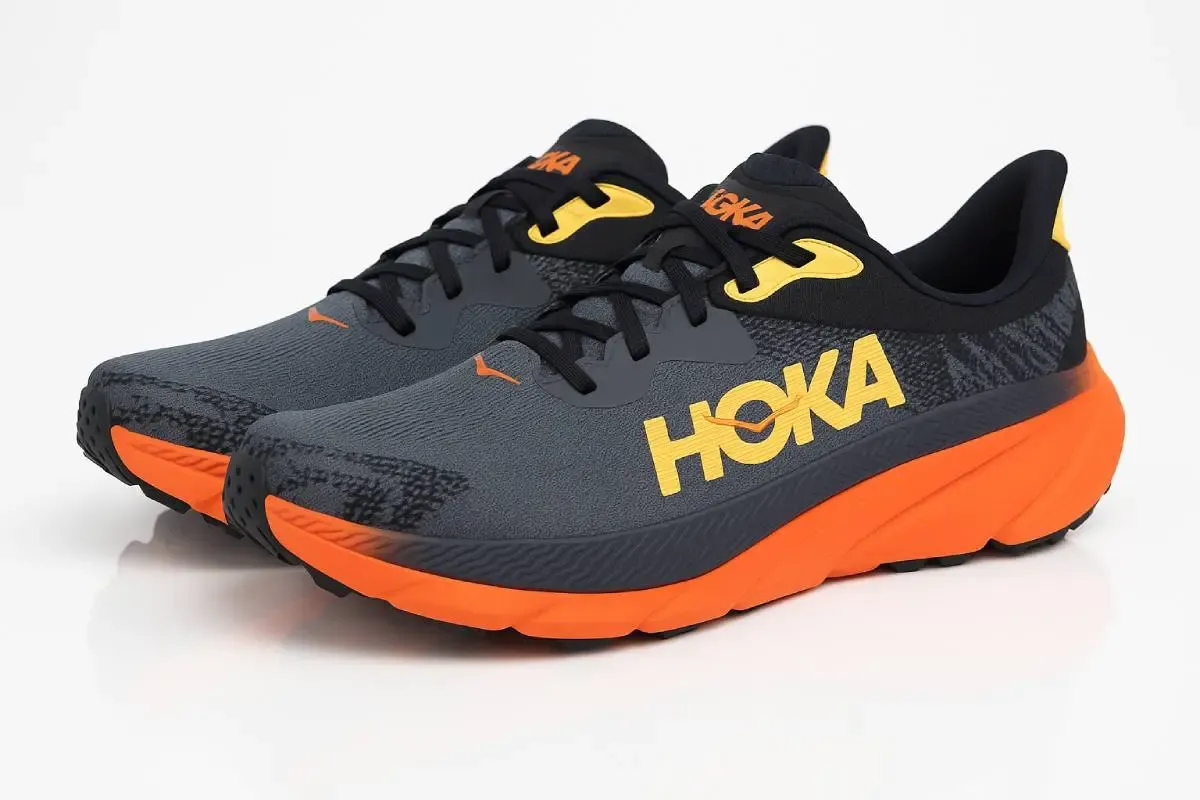
Short answer
The Hoka Challenger 7 is a hybrid, dual-purpose door-to-trail runner that delivers a cushioned, rolling ride, but its performance is heavily influenced by unique anatomical constraints. While it fits true to size (TTS) in physical length for standard feet, the upper features a snug fit through the midfoot and tapers aggressively in the toe box.
Runs true to size
Cross-sizing: what size to buy
Find a shoe you already own and read across to the Hoka Challenger 7 size to buy.
| Reference Shoe | US | EU | ||
|---|---|---|---|---|
| Your usual | Buy | Your usual | Buy | |
| Hoka Speedgoat 5 | 10.0 | 10.0 (Standard) or 10.0 (EE Wide) | 44 | 44 (Standard) or 44 (EE Wide) |
| Hoka Clifton 9 | 10.0 | 10.0 | 44 | 44 |
| Nike Pegasus Trail 4 | 10.0 | 10.5 | 44 | 44.5 |
| Brooks Cascadia 18 | 10.0 | 10.5 | 44 | 44.5 |
-
Hoka Speedgoat 5
Your usual Buy US 10.0 10.0 (Standard) or 10.0 (EE Wide) EU 44 44 (Standard) or 44 (EE Wide) -
Hoka Clifton 9
Your usual Buy US 10.0 10.0 EU 44 44 -
Nike Pegasus Trail 4
Your usual Buy US 10.0 10.5 EU 44 44.5 -
Brooks Cascadia 18
Your usual Buy US 10.0 10.5 EU 44 44.5
Fit Notes
- Hoka Speedgoat 5
- Both models share a highly consistent physical length and stack height profile. However, while the Speedgoat 5 utilizes a flexible, stretchy vamp that effortlessly expands with foot swelling, the Challenger 7 features a stiffer upper that tapers much more severely in the forefoot. If you are on the upper boundary of a standard width in the Speedgoat, do not automatically size up in length—which would create unnecessary heel slippage; instead, maintain your true length and select the dedicated Wide (EE) variant to ensure adequate forefoot space.
- Hoka Clifton 9
- Built on a very similar rocker geometry, these two sibling models exhibit identical length measurements. The Challenger 7 employs a slightly wider platform base to improve trail stability over uneven terrain. However, do not mistake a wider platform for a wider upper: the Challenger 7's upper volume is significantly snugger and tapers much faster at the toes, making the standard version feel tighter in the toe box than the Clifton 9.
- Nike Pegasus Trail 4
- The Pegasus Trail 4 is built with a traditionally rounded toe box that allows standard-width feet plenty of room for natural metatarsal splay and handles thermal expansion well. Because the Challenger 7 tapers aggressively to a restrictive 70.6 mm at the big toe, runners transitioning from the Pegasus Trail 4 must size up by a half size to achieve comparable forefoot comfort, particularly if they are choosing the non-stretch, low-volume GTX version of the Challenger.
- Brooks Cascadia 18
- The Brooks Cascadia is constructed on a wider, highly durable last, offering a spacious and traditional square forefoot in its standard width. Due to the aggressive forefoot taper and low ceiling height of the Challenger 7, runners transitioning from the Cascadia's roomy toe box should size up by a half size (or choose the Challenger 7 Wide EE variant) to prevent painful friction along the outer toes and metatarsophalangeal joints.
Sizing FAQ
Does the Hoka Challenger 7 run true to size?
Yes, the Hoka Challenger 7 runs true to size in physical length for standard-width runners under normal training conditions. However, for ultra-marathon runners or hikers covering long distances, natural foot swelling will quickly overwhelm the restricted vertical and lateral volume. In these long-distance scenarios, sizing up by a half or full size is recommended to prevent your toes from constantly jamming into the front bumper on steep downhills. Additionally, the waterproof GTX version utilizes a rigid, non-stretch internal bootie that reduces internal volume, typically requiring a half-size increase.
Is the Hoka Challenger 7 good for wide feet?
In its standard (D) width, the Challenger 7 is not recommended for wide feet. Laboratory testing shows that the toe box tapers dramatically to 70.6 mm near the big toe and features a low vertical ceiling of 24.9 mm, leaving inadequate room for natural metatarsal splay and causing friction blisters or premature upper mesh blowouts. To accommodate wider profiles, Hoka offers the standard mesh model in a dedicated Wide (EE) size. Note that the waterproof GTX version is not made in a wide variant; wide-footed runners should avoid the GTX version entirely rather than sizing up too much, which introduces uncorrectable heel slippage.
How is the arch support on the Hoka Challenger 7?
The Hoka Challenger 7 delivers moderate, neutral, and highly non-intrusive arch support. Instead of employing a rigid medial post or a dense foam wedge, it supports the midfoot naturally using Hoka's signature wide midsole platform and curved sidewalls to cradle the foot securely. While this works beautifully for low-to-medium arches, the low internal volume and low-profile heel collar (under 2 inches) mean the shoe does not accommodate thick aftermarket orthotics well. Inserting a high-volume insole lifts the foot too high, exacerbating toe box pressure and triggering severe heel slippage.
Specs & Sizing
| Weight | 252 g |
|---|---|
| Retail price | $145 |
| Price on Amazon | $108 - $145 |
| Release year | 2023 |
| Upper | Engineered mesh with recycled materials, soft and plush interior, gusseted tongue, flared heel collar |
| Midsole | Compression-molded EVA foam, rockered geometry |
| Outsole | Durabrasion rubber with 4mm multi-directional lugs |
| Technologies | Active Foot Frame for stability, Meta-Rocker geometry |
| Fit & sizing | True to size, but consider wide version for broader feet |