Founder & Lead Editor
Federico D'anna
Federico D'anna has spent 9 years reviewing sneakers with a methodology built on hands-on wear notes, side-by-side comparisons, and verified buyer feedback.
Learn more about Federico D'annaHighlights
Positive
- Unmatched energy return that genuinely makes fast paces feel easier.
- Incredibly lightweight design that disappears on foot during long races.
Negative
- Durability is a major weak point, with peak performance fading after just 150 miles.
Nike Vaporfly 4 Sizing & Fit Guide
The Nike Vaporfly 4 delivers an ultra-lightweight, high-performance racing experience that runs true to size (TTS) for athletes with standard or narrow foot shapes. Featuring a low-volume toe box and an unyielding structured engineered mesh upper, it provides an exceptionally snug, locked-down fit built for maximum energy transfer. While the updated architecture provides improved lateral relief and stability compared to historical racing flats, its streamlined design offers zero stretch, making careful sizing critical for runners managing volume and width.
Compare your current pair to find the best size match.
| Reference Shoe | Your Usual US | Buy in US | Your Usual EU | Buy in EU | Fit Notes |
|---|---|---|---|---|---|
| Nike Vaporfly 3 | 10.0 | 10.0 / 10.5 | 44 | 44 / 44.5 | The Vaporfly 4 features a lower-volume toe box and a snugger, more aggressive engineered mesh upper compared to the spacious, high-volume forefoot of the Vaporfly 3. Narrow feet should stay TTS to maintain proper plate alignment. However, because the VF4 reduces upper volume drastically, runners with wide or high-volume feet require a half-size increase to avoid toenail trauma, compensating for the tighter fit without causing excessive linear length issues. |
| Nike Alphafly 3 | 10.0 | 10.0 / 10.5 | 44 | 44 / 44.5 | The Alphafly 3 is constructed with a highly accommodating forefoot and a wider platform. To replicate the spatial comfort of the Alphafly 3, runners with average to wide feet should go a half-size up in the Vaporfly 4 due to its ultra-streamlined, race-conforming silhouette. This sizing adjustment directly addresses the narrow lateral profile of the target shoe while ensuring structural alignment. |
| Adidas Adizero Adios Pro 4 | 10.0 | 10.0 | 44 | 44 | While the Adizero Adios Pro 4 is softer and slightly wider overall, both models fit true to size length-wise. A direct 1:1 size transition is recommended, though the Nike Vaporfly 4 will provide a noticeably snugger, more locked-down race fit. No cross-sizing length compensation is necessary for standard width profiles. |
| Nike Air Force 1 | 9.5 | 10.0 | 43 | 44 | The Nike Air Force 1 famously runs large due to its spacious lifestyle toe box, requiring users to size down 0.5 relative to standard athletic shoes. Consequently, buyers must purchase a half-size larger in the Vaporfly 4 compared to their standard Air Force 1 size to ensure sufficient length and counteract the low-volume, high-performance racing last. |
Does the Nike Vaporfly 4 run true to size?
The Nike Vaporfly 4 runs true to size (TTS) for runners with narrow to standard foot shapes, providing a highly secure, high-performance racing fit. However, because the vertical volume inside the toe box is exceptionally low, the upper conforms very tightly over the top of the toes. Runners who prefer a more relaxed fit, those with high-volume feet, or those on the boundary between sizes are strongly advised to size up a half-size to ensure sufficient toe clearance and prevent nail damage. Female athletes may also need to size up a half to a full size relative to standard daily trainers due to the narrow racing last.
Is the Nike Vaporfly 4 good for wide feet?
The Nike Vaporfly 4 is explicitly not recommended for wide feet. The engineered mesh upper is stiff and structured, offering virtually no stretch or lateral accommodation. While the midfoot platform has been widened slightly compared to the Vaporfly 3 to improve cornering stability, the overall footprint remains highly narrow and contoured. Wide-footed runners who attempt to wear the Vaporfly 4 will likely experience intense pressure on the lateral sides of the foot, severe hot spots, and painful blisters, and should consider alternatives like the Nike Alphafly 3.
How is the arch support on the Nike Vaporfly 4?
The Nike Vaporfly 4 provides a highly structured and distinct arch profile. This sensation is driven by the highly curved carbon Flyplate embedded within the ZoomX foam, which creates a firm, supportive contour directly under the midfoot. While some runners with flat feet or highly sensitive arches may feel a slight pressure or 'overhang' sensation when standing still, this feeling generally dissipates once running at speed. The updated midfoot platform has been widened compared to previous versions, successfully reducing the aggressive under-arch pinching that characterized earlier Nike racing flats.
Ready to experience the Nike Vaporfly 4 Review?
Get yours today with fast shipping from Amazon
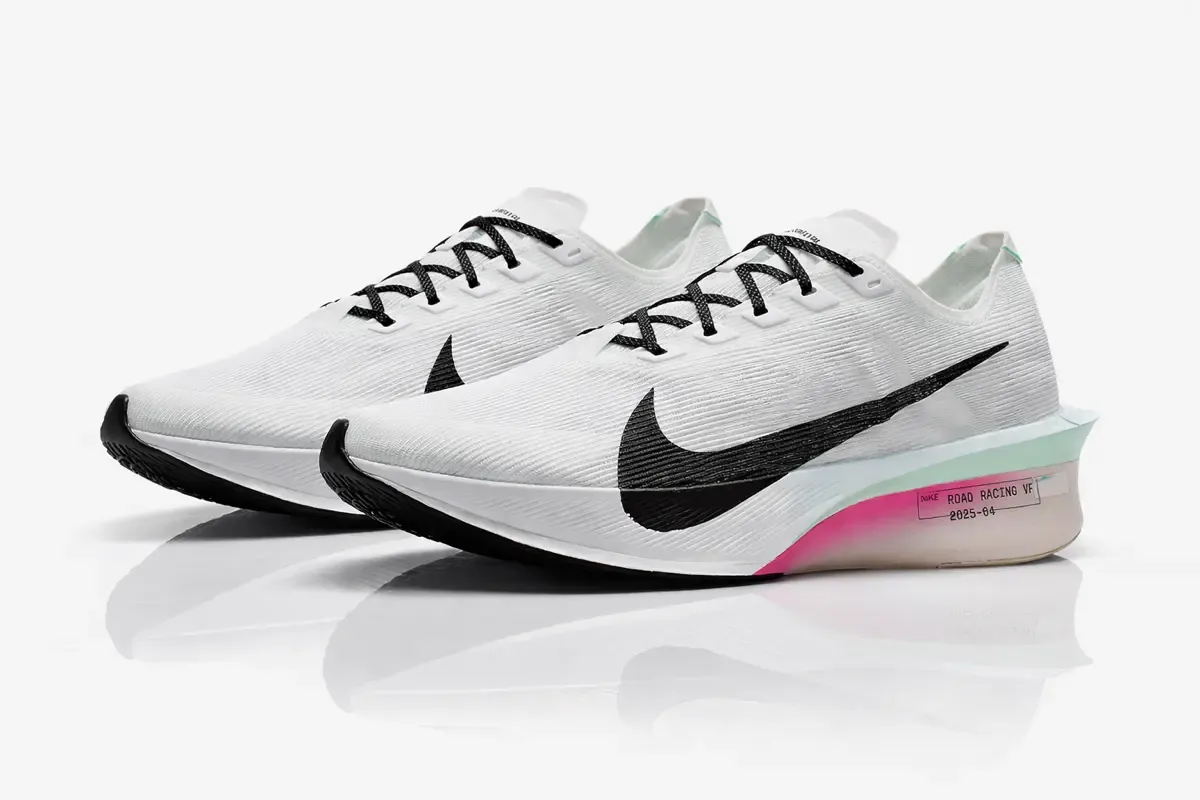
Honestly, keeping up with the “super shoe” wars is a full-time job at this point. But once in a while, a release lands that makes everyone stop and pay attention. The Nike Vaporfly 4 is one of those. Dropping in 2025 as the newest chapter in the line that basically rewrote marathon racing, this version trims things back to feel leaner and sharper. It's more than a refresh. It reads like Nike saying they're still here, and they still want the podium.
Quick Take
Overall Rating: 4.3/5
Best For: 5K to Marathon racing, setting Personal Bests (PBs), elite-level speed sessions.
Key Strengths: Insane energy return, featherlight construction (approx. 190g), aggressive propulsion.
Notable Limitations: Midsole longevity (the "magic" fades fast), narrow fit, high price tag.
Visual Snapshot Summary
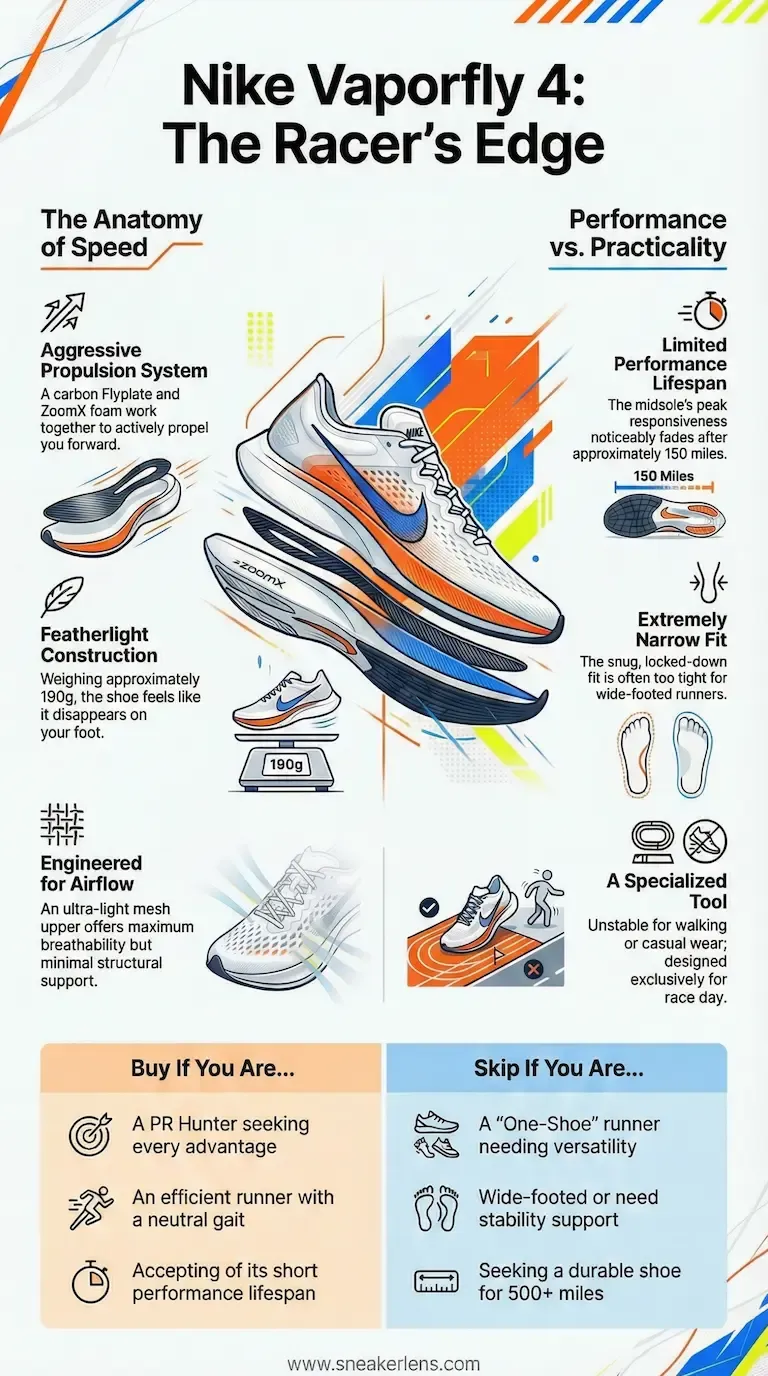
What Makes The Vaporfly 4 Stand Out?
You know what stands out first? The weight. Or really, the lack of it. Nike trimmed grams from the midsole, outsole, and upper versus the Vaporfly 3, and it shows. This is the kind of shoe experts call a “lean, mean, mile-eating machine.” With the Alphafly line taking the “max cushion” marathon slot, the Vaporfly 4 feels more like a scalpel: precise, direct, and seriously fast.
The core magic is still the pairing of ZoomX foam with the full-length carbon Flyplate. Studies on earlier versions pointed to a 4% improvement in running economy, and the Vaporfly 4 feels like it's chasing every last bit of that advantage. It doesn't just bounce. It pushes you forward. One runner summed it up perfectly, saying the shoe "helps me sustain a pace to keep going" even when the legs are screaming. This is a purebred racer, and it trades everyday ease for raw speed.
Real Customer Experiences
The buzz around the Vaporfly 4 is loud, but so are the complaints about price versus lifespan. Here's the general vibe:
- Speed is King: Runners consistently report hitting PB times, feeling a distinct "push" from the carbon plate.
- The "Cinderella" Fit: It's tight. Like, really tight. Many users suggest going up half a size if you don't like your toes being crushed.
- The "150-Mile" heartbreak: There is a widespread acknowledgement that the peak "magic" of the foam starts to dull after about 150 miles, turning these into expensive training shoes rather quickly.
"The shoe fits like a glove, and it helps me sustain a pace to keep going. Everything I could ever ask for." — JerryG105095332, Nike.com
"Only issue is they fit so tight around the toe box. I'm going to have to return & get 10.5. Other than that love the feel/look." — Salvador610451094, Nike.com
Design and Build Quality
Let's break down the tech, because there's a lot packed into this chassis.
- Upper: Nike uses a new, ultra-lightweight engineered mesh. It's wildly breathable (you can practically see your socks), but it doesn't bring much structure. Great for saving weight, not great for lateral support.
- Midsole: This is the star of the show. The ZoomX foam is sculpted to remove any material that isn't strictly necessary for forward motion. It houses the Flyplate, which acts as a lever to flick you forward.
- Outsole: To save weight, rubber coverage is minimal, placed only in high-wear zones at the forefoot and heel. Surprisingly, the rubber itself holds up fine. It's the foam underneath that usually gives up first.
- Weight: At approximately 190g (Men's US 10), it is ludicrously light. You barely feel it on your foot.
Durability is the elephant in the room. The carbon plate can last for thousands of miles, but ZoomX is the tragic hero here: it burns bright and burns out fast. Expect compression wrinkles early on.
Comfort and Fit
Real talk: these aren't “comfortable” like recovery slides. They're “race comfortable.” The fit is aggressive and locked down.
- Sizing Advice: True to size for a race fit, but go up half a size if you have wide feet or prefer a bit of room for toe splay. The toe box is notoriously snug.
- Width Profile: Narrow. If you have wide feet, you might feel like your foot is spilling over the edge of the midfoot.
- Break-in: Non-existent. They are ready to rip right out of the box. In fact, you shouldn't break them in too much, or you're wasting their limited lifespan.
One runner noted, "The shoe fits like a glove," which is great if you like gloves, but claustrophobic if you don't.
Style and Versatility
Aesthetically, the Vaporfly 4 screams “I am faster than you.” The silhouette is sharp and aerodynamic, and it looks quick even when it's just sitting there. The “Proto” colorways and neon gradients are classic Vaporfly.
Versatility, though? Forget it. This is a specialized tool. Wearing these for a casual walk or a gym session is like using a Formula 1 car to pick up groceries: awkward, unstable, and honestly a waste. They're also bad for standing around because of the squishy heel and minimal support. Save them for the days that matter.
Quality and Durability
This is where the relationship gets complicated. Build quality is high (no glue stains, no loose stitching), but the material durability is intentionally low in the name of performance.
- Praise: ~55% of users are happy, accepting the trade-off for speed.
- Common Issues: The midsole foam compressing and losing its "pop" after 150 miles.
- The Reality: Think of these as "consumables" rather than durable goods.
"The magic begins to diminish after approximately 150 miles of use." — Slowtwitch Forum User
Decision Matrix
| Scenario ↓ / Criterion → | Comfort | Breathability | Rain/Grip | Style |
|---|---|---|---|---|
| Daily Urban | ✕ | ✓ | ✕ | ✓ |
| Office Casual | ✕ | ✓ | ✕ | ✓ |
| Light Sport / Gym | ○ | ✓ | ✕ | ○ |
Legend: ✓ = Good ○ = Average ✕ = Poor
Who Should Buy
Perfect For
- The PR Hunter: You are training for a specific marathon or half-marathon and want every possible mechanical advantage.
- The Elite Racer: You need a shoe that disappears on your foot and provides maximum energy return at sub-6:00/mile paces.
- The Efficient Runner: You have a neutral gait and don't need stability support to get you to the finish line.
Consider Alternatives If
- The One-Shoe Warrior: If you want one shoe to do it all (training, racing, walking), this is absolutely not it.
- The Wide-Footed: You will likely find the midfoot painfully narrow and the arch support intrusive.
- The Durability Seeker: If getting 500+ miles out of a shoe is a priority for you, look elsewhere (perhaps the Adidas Adios Pro series).
- The Overpronator: The lack of stability features means your ankles will be working overtime.
Final Verdict
The Nike Vaporfly 4 remains the gold standard for pure racing speed. It is an uncompromising piece of engineering that delivers exactly what it promises: a faster, more efficient run. However, that performance comes at a literal and metaphorical cost. It is fragile, expensive, and specialized. If you can stomach the price tag for a shoe that might only last two training blocks, it is arguably the best weapon you can put on your feet.
Browse our full Nike collection to find your perfect pair.
As an Amazon Associate we earn from qualifying purchases. This helps support our site so we can keep bringing you the best content!
Frequently Asked Questions
How many miles does the Nike Vaporfly 4 last?
Should you train in the Vaporfly 4 or save it for race day?
What is the difference between Vaporfly 4 and Alphafly 3?
Related Reviews
Nike Air Max 270 Review
Get an in-depth review of the Nike Air Max 270. We cover comfort, sizing, durability, style, and value to see if it's the right fit for you.
Nike P-6000 Review
Get an expert review of the Nike P-6000. We analyze its Y2K style, all-day comfort, value, and sizing to see if it's right for you.
Nike Alphafly 3 Review
Nike Alphafly 3 Review: The ultimate marathon racing shoe tested. Discover pros, cons, sizing advice, and why it reigns supreme for elite runners.
Nike Cortez 23 Review
Get an expert review of the Nike Cortez '23. We cover its iconic style, comfort, sizing issues, durability, and value for money. Is it right for you?
Nike Dunk Low Review
Discover the truth about the Nike Dunk Low in our review. We analyze comfort, sizing, durability, and why this icon remains a streetwear staple.
Nike Revolution 7 Review
Get an honest look at the Nike Revolution 7. This in-depth review covers its value, comfort, and style for running, gym, and daily wear. Is it for you?