Short answer
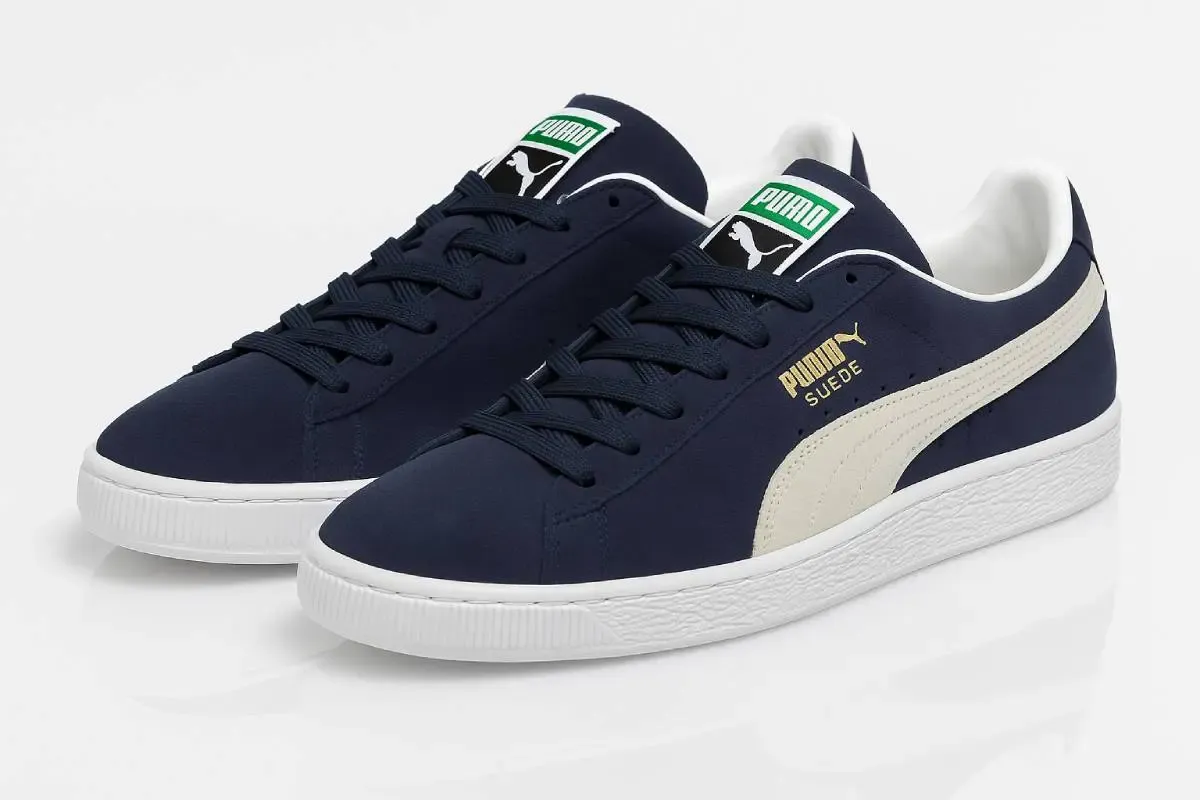
The Puma Suede Classic stands as a foundational lifestyle icon, yet its retro silhouette introduces specific anatomical sizing challenges. While the length aligns accurately with standard true-to-size (TTS) parameters, the vintage court last features a notably narrow midfoot and a sharply tapering toe box.
Runs true to size
Cross-sizing: what size to buy
Find a shoe you already own and read across to the Puma Suede Classic size to buy.
| Reference Shoe | US | EU | ||
|---|---|---|---|---|
| Your usual | Buy | Your usual | Buy | |
| Nike Air Force 1 | 10.0 | 10.5 | 44 | 44.5 |
| Nike Dunk Low | 10.0 | 10.0 (Narrow/Average) / 10.5 (Wide) | 44 | 44 (Narrow/Average) / 44.5 (Wide) |
| Adidas Samba | 10.0 | 10.0 | 44 | 44 |
| Converse Chuck Taylor / Chuck 70 | 9.5 | 10.0 | 43 | 44 |
| Puma Clyde | 10.0 | 10.5 | 44 | 44.5 |
| Puma RS-X | 10.0 | 10.5 | 44 | 44.5 |
-
Nike Air Force 1
Your usual Buy US 10.0 10.5 EU 44 44.5 -
Nike Dunk Low
Your usual Buy US 10.0 10.0 (Narrow/Average) / 10.5 (Wide) EU 44 44 (Narrow/Average) / 44.5 (Wide) -
Adidas Samba
Your usual Buy US 10.0 10.0 EU 44 44 -
Converse Chuck Taylor / Chuck 70
Your usual Buy US 9.5 10.0 EU 43 44 -
Puma Clyde
Your usual Buy US 10.0 10.5 EU 44 44.5 -
Puma RS-X
Your usual Buy US 10.0 10.5 EU 44 44.5
Fit Notes
- Nike Air Force 1
- The Nike Air Force 1 is built on an oversized, highly spacious last with a rounded toe box and traditionally runs a half-size large. Because the Puma Suede Classic is engineered with a much narrower midfoot and a lower overall volume, users must size up a half-size (+0.5) from their AF1 size to achieve a comparable fit and prevent severe forefoot crowding.
- Nike Dunk Low
- The Nike Dunk Low fits true to size with a standard, moderately accommodating toe box. Narrow and average-width feet can map their Dunk size directly to the Puma Suede Classic. However, wide-footed users must go up a half-size (+0.5) to offset the Suede's tapered forefoot architecture and avoid structural compression along the metatarsal heads.
- Adidas Samba
- Both models represent classic low-profile terrace designs built on narrow, streamlined athletic lasts, with the Adidas Samba running narrow across the forefoot to match the tight lateral tolerances of the Puma Suede. Regarding the width compensation factor: if you are a wide-footed wearer who already sizes up a half-size in the Samba strictly to gain width, maintain that same up-sized baseline here; do not step down to your true technical length, as the Puma Suede will not provide extra horizontal volume.
- Converse Chuck Taylor / Chuck 70
- Converse Chuck Taylors are notoriously elongated silhouettes that typically require users to downsize by a half to a full size from their standard measurement. A consumer who comfortably wears a US 9.5 (EU 43) in Chuck 70s will find that the Puma Suede Classic fits optimally in a US 10.0 (EU 44) due to the Puma's more traditional length scaling and narrower midfoot boundaries.
- Puma Clyde
- Despite a shared design heritage, the Puma Clyde is engineered on a slightly wider last, making it substantially more accommodating for wide feet out of the box. Transitioning from the Clyde to the Suede Classic requires a half-size increase (+0.5) for medium-to-wide foot profiles to circumvent excessive midfoot constriction and pinky toe pressure.
- Puma RS-X
- The RS-X is a bulky, modern lifestyle sneaker featuring a highly spacious toe box that prompts many users to size down. Because the Suede Classic relies on a much tighter, lower-volume retro mold, buying a half-size larger than your RS-X size is necessary to prevent severe toe pinching.
Sizing FAQ
Does the Puma Suede Classic run true to size?
For individuals with narrow to average foot structures, the Puma Suede Classic runs true to size in length, mapping accurately to standard US and UK charts without crowding the front of the shoe. However, the physical silhouette features an inherently narrow midfoot and tapers sharply at the forefoot. Because of this narrow court architecture, wide-footed consumers will find their true-to-size length highly restrictive and must adjust their sizing upward. Minor volume differences also exist based on manufacturing origin, with Vietnamese-made pairs fitting slightly looser than those from Cambodia.
Is the Puma Suede Classic good for wide feet?
The Puma Suede Classic is generally not recommended for wide feet, as it stands as one of the narrowest models within Puma's lifestyle lineup. The flat, narrow cupsole platform severely restricts natural toe splay. While the premium suede upper is highly pliable and offers moderate stretch over time, it cannot expand past the rigid physical boundaries of the rubber sole unit. Broad-footed buyers (E/EE width) must size up by a half to a full size to alleviate lateral pressure. Extra-wide feet (EEE width) should avoid this model entirely, as sizing up enough to accommodate width introduces excessive length and severe heel slippage.
How is the arch support on the Puma Suede Classic?
The Puma Suede Classic provides flat to minimal arch support, utilizing a retro cupsole architecture that lacks modern orthopedic contours, polyurethane crash pads, or active foam cushioning. For users with flat feet or low arches, the exceptionally narrow middle section of the sole can cause the medial arch to spill over the rubber edge, resulting in friction against the suede wall and arch fatigue. Remedying this with thick aftermarket orthotics is highly discouraged; the shoe features a low-profile heel counter, meaning that elevating the footbed pushes the heel out of its secure pocket, triggering severe heel slippage and gait instability.
Specs & Sizing
| Weight | 397 g |
|---|---|
| Retail price | $70 |
| Release year | 1968 |
| Upper | Primarily crafted from quality suede, featuring a contrast PUMA Formstrip. The ankle collar and tongue have a synthetic leather lining and foam padding for comfort [1, 2, 3, 4, 6, 7, 9, 23, 24, 25, 26, 27, 28, 29]. |
| Midsole | Constructed from rubber with a removable EVA insole for basic cushioning. It offers minimal arch support [2, 5, 6, 8, 24, 27, 28, 30]. |
| Outsole | A durable rubber cupsole with a ribbed toe bumper and signature 360° stitching, providing excellent grip [2, 4, 5, 6, 7, 9, 20, 27, 28, 29, 31]. |
| Technologies | Use of suede material in 1968, which was innovative for athletic footwear at the time [1, 3, 4, 10, 11, 23, 26, 32, 33]., The 'Clyde' variation, a signature model for Walt 'Clyde' Frazier, was the first-ever signature shoe for an NBA player [2, 5, 7, 8, 9, 11, 14, 16, 34]. |
| Fit & sizing | Generally fits true to size in length. However, it's recommended to size up by at least half a size for those with wider feet [1, 2, 3, 4, 5, 6, 7, 39, 40, 41, 42, 43, 44, 45, 51, 53]. |