Short answer
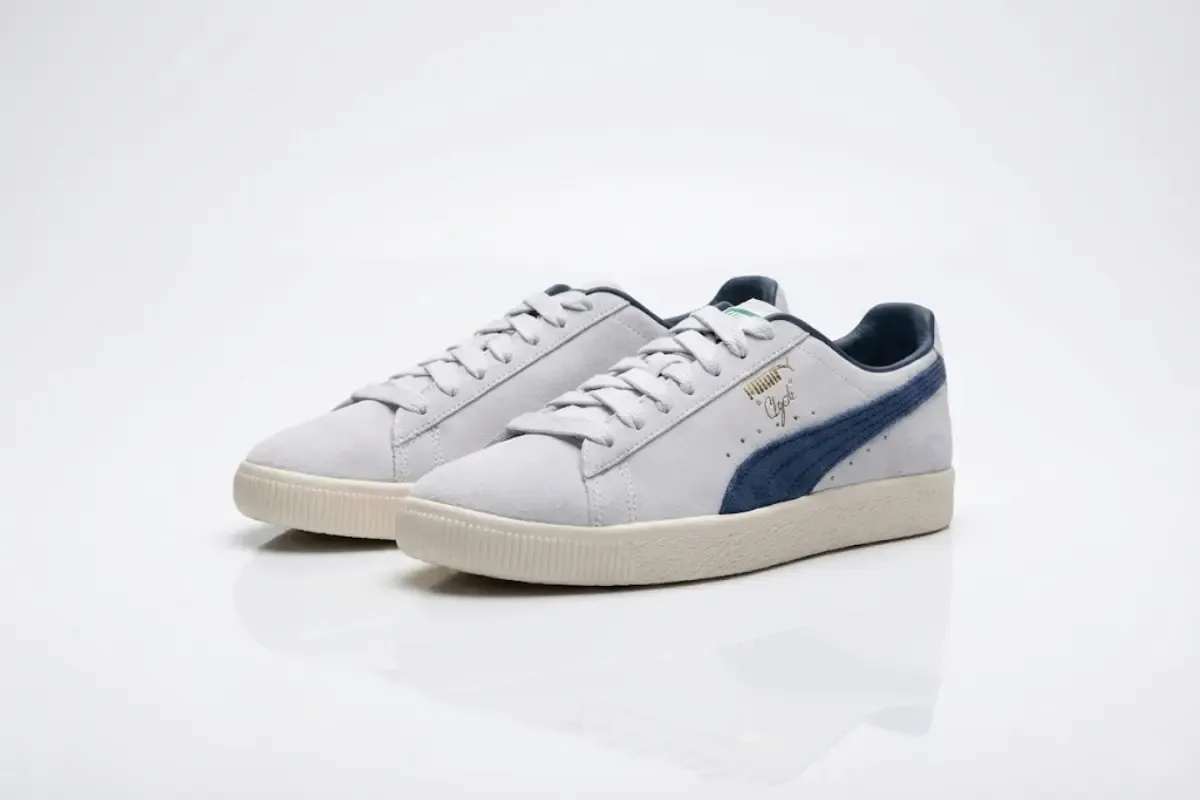
The Puma Clyde represents a legendary intersection of athletic heritage and street culture, maintaining a prominent position in the sneaker landscape for over half a century. General consensus indicates that lifestyle iterations of this classic silhouette run true to size (TTS) in terms of longitudinal length.
Runs true to size
Cross-sizing: what size to buy
Find a shoe you already own and read across to the Puma Clyde size to buy.
| Reference Shoe | US | EU | ||
|---|---|---|---|---|
| Your usual | Buy | Your usual | Buy | |
| Nike Air Force 1 (AF1) | 10 | 10.5 | 44 | 44.5 |
| Adidas Samba | 10 | 10 | 44 | 44 |
| Nike Dunk Low | 10 | 10 (TTS) or 10.5 (Wide Feet) | 44 | 44 (TTS) or 44.5 (Wide Feet) |
| Puma Suede Classic | 10 | 10 | 44 | 44 |
-
Nike Air Force 1 (AF1)
Your usual Buy US 10 10.5 EU 44 44.5 -
Adidas Samba
Your usual Buy US 10 10 EU 44 44 -
Nike Dunk Low
Your usual Buy US 10 10 (TTS) or 10.5 (Wide Feet) EU 44 44 (TTS) or 44.5 (Wide Feet) -
Puma Suede Classic
Your usual Buy US 10 10 EU 44 44
Fit Notes
- Nike Air Force 1 (AF1)
- The Nike Air Force 1 is widely recognized for running a half-size large and providing a notably roomy toe box. Conversely, the lifestyle Puma Clyde is built on a narrower, truer-to-size last. Because the Clyde has a more streamlined profile, buyers must size up a half-size (0.5 US) from their standard AF1 size to secure a comfortable fit and avoid tight toe tapering.
- Adidas Samba
- Both the Adidas Samba and the Puma Clyde feature a slim, low-profile design with nearly identical sizing characteristics. However, the Clyde's forefoot is slightly less restrictive than the Samba's highly tapered toe box. Addressing the compensation factor: if you typically size up in the narrow Samba solely to gain extra width, you can comfortably return to your true standard length (US 10 / EU 44) for the Puma Clyde due to its marginally more accommodating forefoot layout.
- Nike Dunk Low
- The Nike Dunk Low offers a standard, relatively flat fit across the footbed that aligns well with standard universal sizing. Most standard-width wearers can stick with their identical size in the Puma Clyde. However, due to the Clyde's narrower midfoot structure and tapered toe area, those with wider feet should select a half-size larger to prevent lateral pinching.
- Puma Suede Classic
- As sister models, the Puma Suede Classic and the Puma Clyde share a very similar shape and identical length dimensions. However, the Clyde's last is engineered to be slightly wider than the highly narrow Suede Classic, offering a touch more room in the forefoot. Applying the compensation factor: if you normally size up in the Suede Classic purely for width comfort, you can safely return to your true length size in the Clyde.
Sizing FAQ
Does the Puma Clyde run true to size?
The lifestyle versions of the Puma Clyde generally run true to size (TTS) in length, making them a safe choice in your standard size for narrow to average feet. However, minor variations exist across production batches and specific models; for instance, the Clyde Varsity II runs slightly long, prompting some to go down a half-size, while pairs from Vietnam can feel roomier than those manufactured in Cambodia. Performance basketball editions diverge significantly: the Clyde All-Pro runs small due to its stiff, non-stretch Matryx upper, the Clyde Hardwood fits true to size once broken in, and the Clyde Court Disrupt runs long.
Is the Puma Clyde good for wide feet?
The classic lifestyle Puma Clyde is generally not recommended for individuals with wide feet unless a sizing adjustment is made. Although originally designed to be wider than the Puma Suede, its retro shape still features a tapered toe box and a narrow midfoot profile that can cause uncomfortable lateral pressure and pinching. To ensure comfort, wide-footed buyers should go up a half-size, which grants vital horizontal clearance across the forefoot despite leaving some extra length at the tip. When it comes to performance models, wide-footers should avoid the tight Clyde All-Pro and consider the Clyde Hardwood's more forgiving leather construction.
How is the arch support on the Puma Clyde?
The lifestyle Puma Clyde offers minimal natural arch support, as it is built on the flat rubber cupsole tooling characteristic of 1970s court shoes. While the structured leather lining provides basic baseline stability, the flat footbed can cause strain during extended periods of walking or standing for users with high arches, who may need to replace the factory insoles with custom orthotics. In contrast, modern performance variants like the Clyde Hardwood provide excellent arch stability via a firm ProFoam midsole and an extensive supportive TPU cage.
Specs & Sizing
| Weight | 966 g |
|---|---|
| Retail price | $120 |
| Price on Amazon | $85–$140 |
| Release year | 1973 |
| Upper | Varies by model: Lifestyle—100% cow leather, suede, or hairy suede; Performance—engineered mesh with synthetic leather overlays |
| Midsole | Lifestyle—standard rubber/EVA; Performance—NITRO™ SQD (All-Pro Nitro) or ProFoam+ with Pebax® heel (All-Pro) |
| Outsole | Lifestyle—solid rubber with herringbone/checker; Performance—translucent rubber with optimized traction pattern |
| Technologies | NITRO™ SQD foam, Pebax® heel unit, TPU shank plate, Gold foiled Clyde branding, Cord lock-down lacing (performance) |
| Fit & sizing | True to size for narrow-to-normal feet; size up ½ for wide feet due to zero-stretch upper materials |