Founder & Lead Editor
Federico D'anna
Federico D'anna has spent 9 years reviewing sneakers with a methodology built on hands-on wear notes, side-by-side comparisons, and verified buyer feedback.
Learn more about Federico D'annaHighlights
Positive
- The retro aesthetic pairs perfectly with both office attire and casual weekend looks.
- Deep discounts frequently make this one of the most affordable heritage sneakers on the market.
Negative
- The thin midsole lacks the plush cushioning fans of modern 'super foams' might expect.
Puma Easy Rider Sizing & Fit Guide
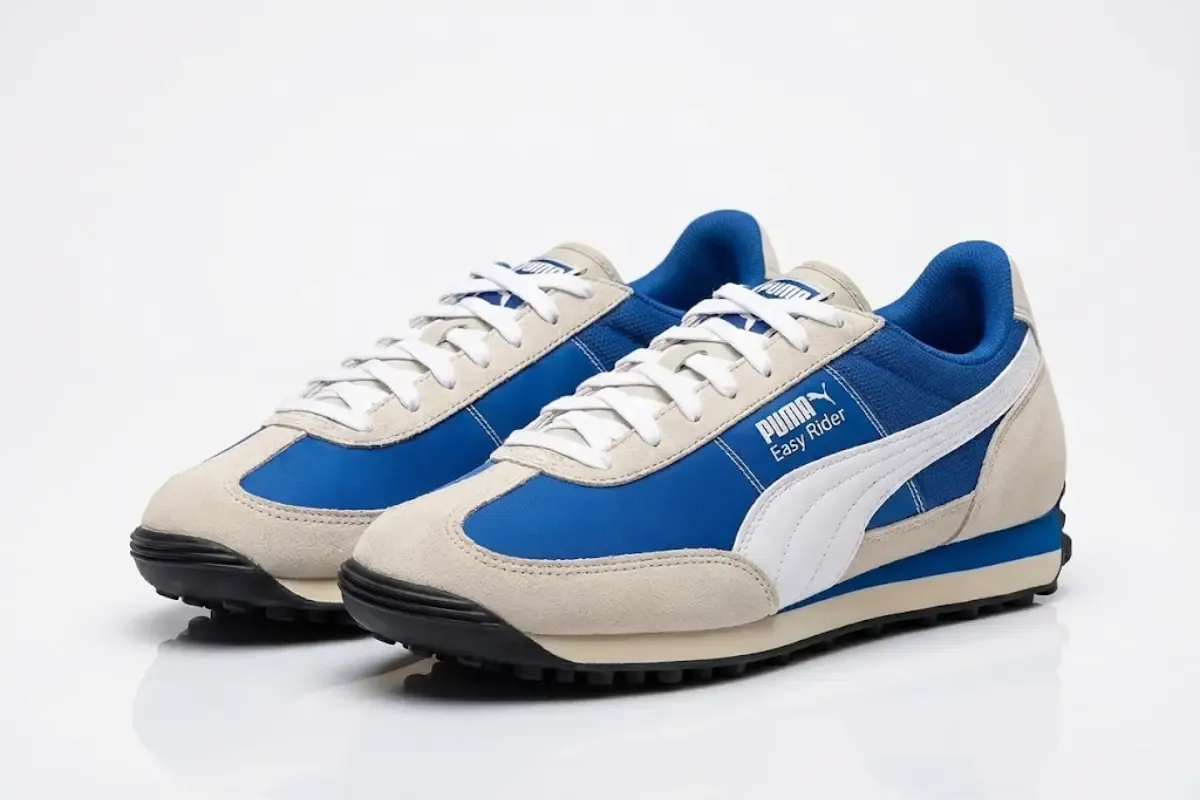
The PUMA Easy Rider is a seminal 1970s retro runner featuring a highly streamlined, narrow silhouette and a sharply tapered toe box. While it delivers excellent midfoot lockdown and an authentic vintage terrace aesthetic, its low-profile geometry introduces distinct sizing nuances. The shoe generally fits true to size (TTS) for narrow and average foot profiles, providing a snug and secure containment. However, because the narrow midsole bed lacks extensive lateral relief, individuals with wide feet or those accustomed to the spacious, highly cushioned structures of modern athletic sneakers will need to adjust their sizing to avoid painful localized pressure points along the forefoot.
Compare your current pair to find the best size match.
| Reference Shoe | Your Usual US | Buy in US | Your Usual EU | Buy in EU | Fit Notes |
|---|---|---|---|---|---|
| Adidas Samba | 10 | 10 (Standard) / 10.5 (Wide) | 44 | 44 (Standard) / 44.5 (Wide) | Both models share a 1970s athletic heritage characterized by a narrow, low-profile silhouette and a tapered toe box. Standard-width feet can maintain their true size across both models as the length and narrow containment are highly comparable. However, if you typically size up in the Samba strictly as a compensation factor to gain extra width, you should apply that same logic and opt for the 10.5 in the Easy Rider to prevent side-toe pinching. |
| Nike Air Force 1 | 10 | 10.5 (Standard) / 11 (Wide) | 44 | 44.5 (Standard) / 45 (Wide) | The Air Force 1 is notorious for its oversized internal volume and spacious toe box, prompting most consumers to size down a half size from their true measurement. Conversely, the Easy Rider runs significantly narrower and closer to the foot. A user wearing a US 10 in the AF1 has likely downsized for length; they will need to step up to a US 10.5 in the Easy Rider for standard feet to achieve an anatomically correct length, or a US 11 to secure adequate lateral relief for a wider foot shape. |
| Nike Dunk Low | 10 | 10 (Standard) / 10.5 (Wide) | 44 | 44 (Standard) / 44.5 (Wide) | The Nike Dunk Low offers a standard, true-to-size medium fit with a moderately roomy forefoot. The Easy Rider features a much sleeker profile and a sharply tapered tip. While average-to-narrow feet can comfortably maintain their standard US 10 because the linear length is true, wide-footed individuals must size up a half size to US 10.5 to accommodate the narrower footprint and prevent excessive pressure along the outer edges of the forefoot. |
| Nike Cortez | 10 | 10 | 44 | 44 | The Nike Cortez and PUMA Easy Rider are direct historical running competitors that share an identically narrow, sleek aesthetic. Both silhouettes run narrow and hug the foot closely, meaning no length or width compensation adjustments are required. A user wearing a standard US 10 in the Cortez will find an identical fit and standard retro-runner containment in a US 10 Easy Rider. |
Does the Puma Easy Rider run true to size?
Yes, for individuals with narrow-to-average foot widths, the PUMA Easy Rider fits true to size (TTS), delivering a snug, vintage athletic lockdown that aligns with its 1970s running heritage. However, due to its narrow silhouette and tapered toe box, those with slightly wider feet should size up by a half size. Additionally, female buyers must be cautious of widespread retail listing errors where unisex/men's inventory is mislabeled as women's models; if buying a unisex pair, women must size down by 1.5 sizes to avoid an excessively loose fit, whereas genuine women's-specific models run small and narrow, requiring a half size up for standard-to-wide feet.
Is the Puma Easy Rider good for wide feet?
No, the PUMA Easy Rider is not recommended as a primary option for individuals with wide or extra-wide feet. The physical footprint of the shoe is distinctly narrow, and the toe box tapers sharply at the lateral edge, which can squeeze the toes inward and cause painful pinching. Furthermore, wide-footed wearers frequently experience a feeling of instability and lateral overhang because the narrow midsole bed does not provide a wide enough base of support. If wide-footers choose to purchase this model, they are strongly advised to size up by a half size to clear the narrow forefoot containment, while those with extra-wide feet should avoid this silhouette entirely, as sizing up a full size to accommodate width leads to excessive length, heel slippage, and compromised walking mechanics.
How is the arch support on the Puma Easy Rider?
The PUMA Easy Rider provides moderate underfoot arch support through its low-profile, dual-density EVA or ProFoam midsole. This specific construction offers a firmer, more stable, and grounded ride compared to the plush, highly cushioned setups found in modern lifestyle running shoes. While approximately 53% of buyers report that the factory support is perfectly comfortable for daily city walking, the relatively flat nature of the classic sole unit means it may not satisfy individuals with high arches or severe overpronation. Wearers requiring significant structural arch support often choose to unlace the top eyelets to relieve tongue pressure or replace the factory insole with structured aftermarket orthotics.
Ready to experience the Puma Easy Rider Review?
Get yours today with fast shipping from Amazon
There's something comforting about a true classic. While the sneaker world keeps yelling about the next “super shoe” with carbon plates and space-age foam, the Puma Easy Rider just sits there, confident in what it is. It doesn't just tell a story of athletic heritage, it is the story, tracing back to the late 1970s when jogging first moved from the track to the city streets. I dug into this model to see if it can handle the modern daily grind or if it's mostly a nostalgia trip. What I found is a mix of budget-friendly accessibility and real style, with a few compromises you should know about.
Quick Take
Overall Rating: 4.5/5
Best For: Daily urban commuting, office casual outfits, budget-conscious buyers, and retro style enthusiasts.
Key Strengths: Exceptional all-day comfort, versatile "dress up or down" aesthetic, lightweight feel, and aggressive value for money.
Notable Limitations: Thin cushioning compared to modern tech, requires maintenance (suede care), and lacks stability for serious sports.
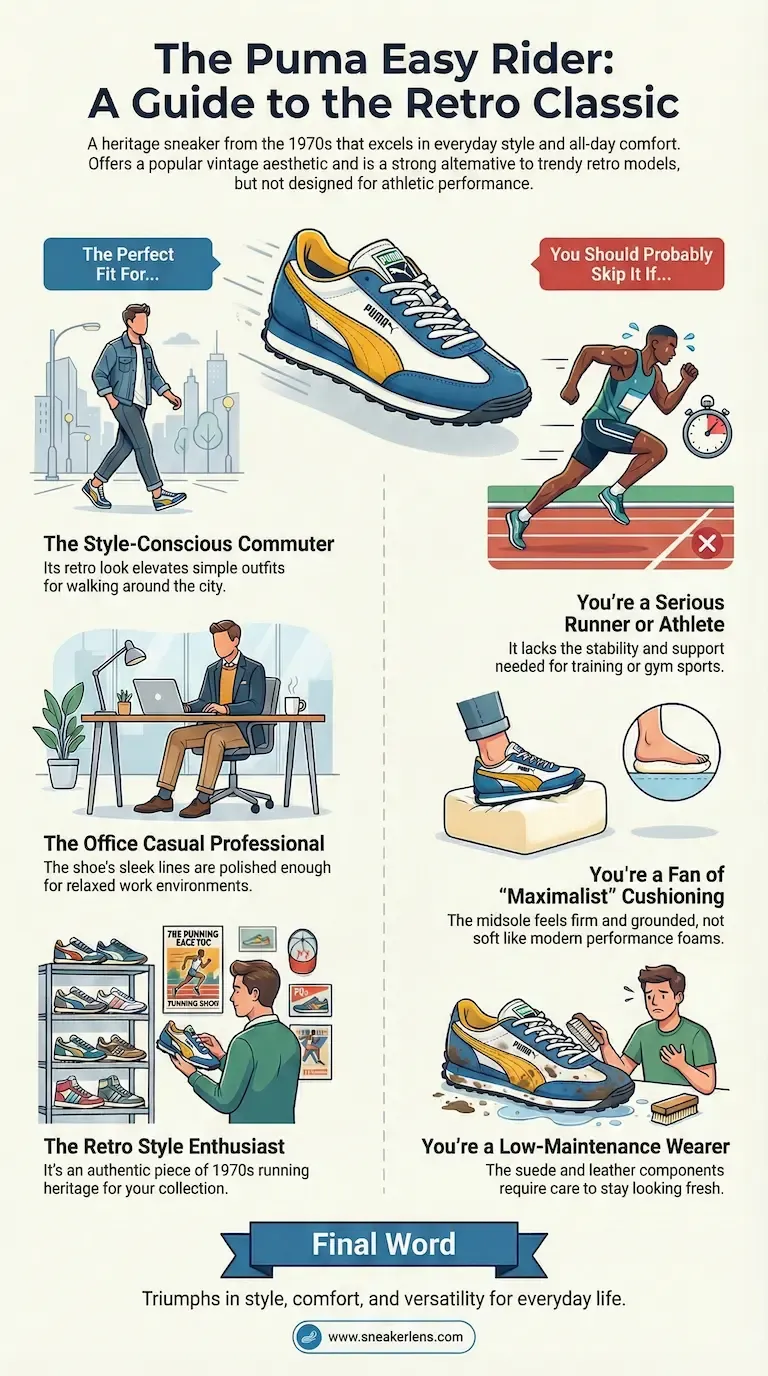
Visual Snapshot Summary
What Makes Puma Easy Rider Stand Out?
So, here's the thing about the Puma Easy Rider: it's riding the nostalgia wave that's taken over the sneaker market. Models like the Adidas Samba and Gazelle are everywhere right now, and the Easy Rider fits into that same cultural pocket as both a modern hit and a genuine artifact of 1970s running culture. What makes it stand out isn't just that it “looks old school.” It delivers that vintage aesthetic at a price point that frankly embarrasses some competitors.
While the standard retail price floats between $54 and $95, it's incredibly common to find this shoe heavily discounted, sometimes dropping as low as $30. That's a massive deal. It turns the Easy Rider from a simple “fashion statement” into a legitimate budget hero for anyone who wants to look good without blowing rent money. It has the iconic look, but it doesn't gatekeep it behind a triple-digit price tag.
One happy customer summed up the vibe perfectly:
"The shoe's versatile style allows it to be dressed up or down, making it suitable for a wide range of occasions... a perfect companion for bringing a touch of easy, retro-style to everyday looks."
Real Customer Experiences
When you look at the sheer volume of feedback, a few patterns show up fast. It's not just marketing hype; real people are putting serious miles on these.
- All-Day Comfort is King: The most consistent feedback is about comfort during long days. Users consistently describe them as suitable for all-day wear, capable of handling long periods of standing or walking without causing pain.
- Office Approved: A surprising number of people are wearing these to work. The sleek lines pair well with polished office attire, bridging that gap between "sneakerhead" and "professional".
- Back Support?: Interestingly, some users specifically mention the lift in the heel providing good support for the back, which is a nice bonus for a casual sneaker.
Here is what actual wearers are saying:
"Comfortable enough shoes to run around in."
"Feels good for [my] lower back."
Design and Build Quality
Here's what you're actually getting for your money, because the construction is more interesting than you'd expect. The Puma Easy Rider isn't built on just one material; it's a composite family of designs.
The Upper The standard description usually points to a "composite upper." This typically means a base of textile or nylon (lightweight and breathable) overlaid with suede and/or synthetic leather panels. This layering isn't just for looks; the suede overlays add reinforcement to high-wear areas like the toe and heel. It also gives the shoe texture that flat leather pairs sometimes lack.
The Midsole This is where you need to pay attention. The more contemporary "Vintage" iterations feature a ProFoam EVA midsole. Don't confuse this with the high-performance "Nitro" foam you see in Puma's elite running shoes. This EVA foam is engineered for lifestyle comfort, not marathon running [38]. It offers cushioning, but it's a firmer, more grounded ride than the squishy clouds you might find in a Hoka or a Boost midsole.
The Outsole The outsole is consistently constructed from rubber, often featuring a lugged pattern that provides durable traction. It's designed to grip a variety of urban surfaces, which is exactly what you want in a commuter shoe.
Weight and Tech While specific gram weights are elusive in the specs, the shoe is generally characterized as "lightweight". Don't expect proprietary chips or air bubbles here. The “tech” is really just classic materials used well, creating a shoe that tends to disappear on your foot.
Comfort and Fit
If you're worried about buying these online, the consensus is that the Puma Easy Rider runs true to size. You likely won't need to play the guessing game of going half a size up or down like you do with some other brands.
Width Profile The shoe is generally offered in a regular width. It has a rounded toe box that users find forgiving, neither famously wide like a New Balance 574 nor painfully narrow. It sits in that "Goldilocks" zone for the average foot.
Break-in Period Here is the good news: there is practically no break-in period. Users report that the shoes feel good right out of the box. Because the materials, nylon and soft suede, are flexible, you don't have to walk around with band-aids on your heels for the first week.
One user noted:
"Super comfortable... comfortable enough to run around in."
Style and Versatility
The style is the main reason you buy this shoe. It has that effortless cool factor that's hard to fake. The sleek lines and retro aesthetic pair well with a huge variety of outfits. I've seen these with sweatpants for a coffee run, and with tailored trousers for a creative office setting, and it just works.
The colorways play a big part here, from vibrant reds to understated tans, adding a pop of fun to simple looks. It's a versatile piece that brings a vintage vibe without making you look like you're wearing a costume. It is polished enough for "Business Casual" but chill enough for Saturday morning.
Quality and Durability
When we talk about quality, we have to talk about the trade-offs. The praise for the Easy Rider is high; related Puma lifestyle models boast ratings around 4.5 stars. Users generally find them durable, noting that they "clean up well" and the construction holds together.
However, the materials are not "set it and forget it." If you opt for a version with genuine leather or suede, you have to take care of it. One user explicitly noted that the leather components need to be conditioned to maintain their integrity. If you treat them like beaters in the rain, that suede is going to suffer.
Also, the "thinness" of the midsole is a durability concern for some—not that it breaks, but that it feels insubstantial if you are used to thicker shoes.
"Thin to what I'm used to."
Decision Matrix
| Scenario ↓ / Criterion → | Comfort | Breathability | Rain/Grip | Style |
|---|---|---|---|---|
| Daily Urban | ✓ | ○ | ○ | ✓ |
| Office Casual | ✓ | ○ | ○ | ✓ |
| Light Sport / Gym | ✕ | ○ | ○ | ✕ |
Legend: ✓ = Good ○ = Average ✕ = Poor
Who Should Buy
Perfect For
- The Style-Conscious Commuter: You want a shoe that looks cool with jeans or chinos and won't hurt your feet after walking ten blocks to the subway. The retro aesthetic elevates a simple outfit instantly.
- The Smart Budget Shopper: You love the look of the Adidas Samba or NB 574 but don't want to pay full price. Finding these for $30-$40 is a massive win for your wallet.
- The Office Casual Professional: You work in a relaxed environment and need a shoe that is polished enough for a meeting but comfortable enough for standing at a desk.
- The Retro Collector: You appreciate the history of the late '70s running boom and want a piece of that
Consider Alternatives If
- The Serious Runner: Do not—and I repeat, do not—buy these for training. They lack the stability, energy return, and support needed for running or gym sports. You will hurt yourself.
- The "Maximalist" Cushion Fan: If you are used to walking on marshmallows (think Hoka or thick Nike ZoomX), the EVA midsole here will feel thin and hard to you.
- The Low-Maintenance Wearer: If you hate the idea of brushing suede or worrying about rain spots, stick to a full synthetic or leather sneaker. These need a little love to stay looking fresh.
Final Verdict
The Puma Easy Rider is a triumph of staying power. It doesn't try to be a high-tech performance monster; instead, it leans hard into what it does best: looking great and feeling good for everyday life. It navigates the intersection of nostalgia and accessibility masterfully, offering a legitimate alternative to the hyped-up, overpriced retro runners currently flooding the market.
Sure, it has its limits—it's not for the gym, and the suede needs care—but for the price, it is arguably one of the best value propositions in the sneaker world right now. If you want a shoe that respects your bank account while upgrading your style game, this is it.
Browse our full Puma collection to find your perfect pair.
As an Amazon Associate we earn from qualifying purchases. This helps support our site so we can keep bringing you the best content!
Frequently Asked Questions
Is the Puma Easy Rider a good alternative to the Adidas Samba?
Is the Puma Easy Rider good for running and working out?
What materials is the Puma Easy Rider made of?
Related Reviews
Puma Cali Review
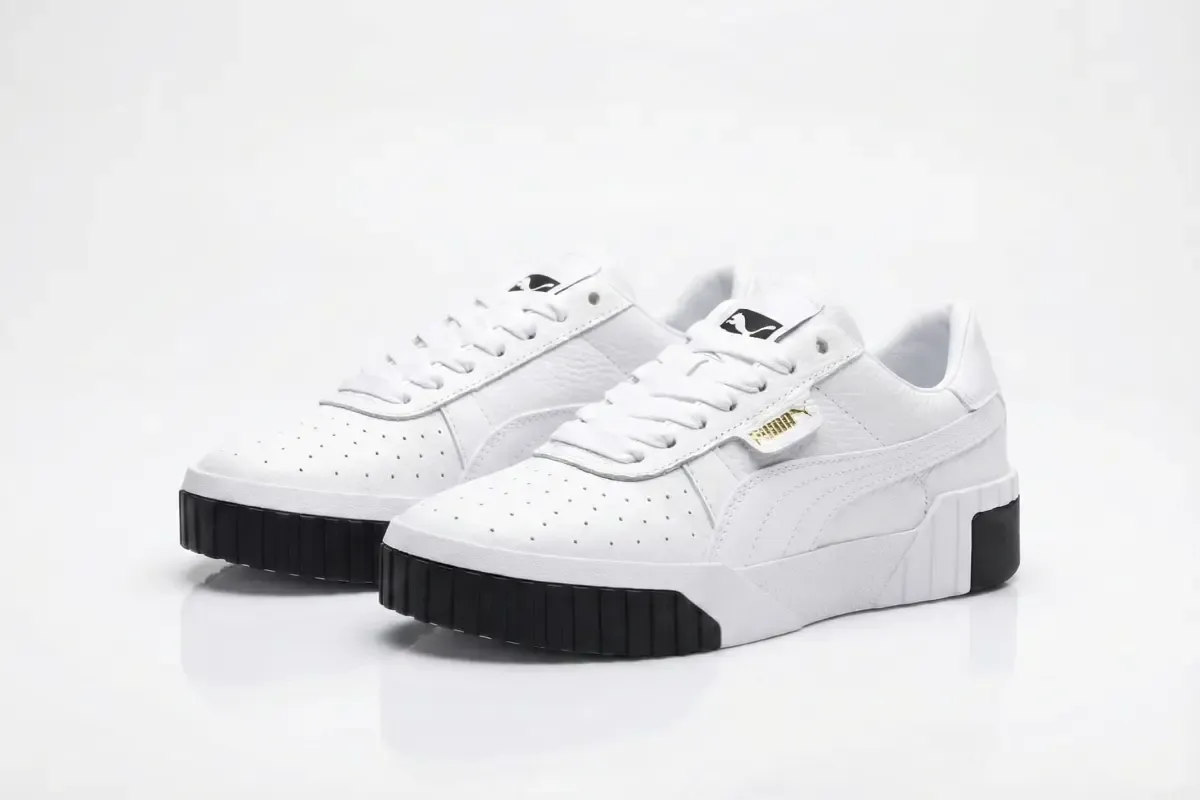
Is the Puma Cali worth the hype? We analyze the fit, comfort, durability, and styling of this retro 80s reissue. Read our deep dive.
Puma Deviate Nitro 3 Review
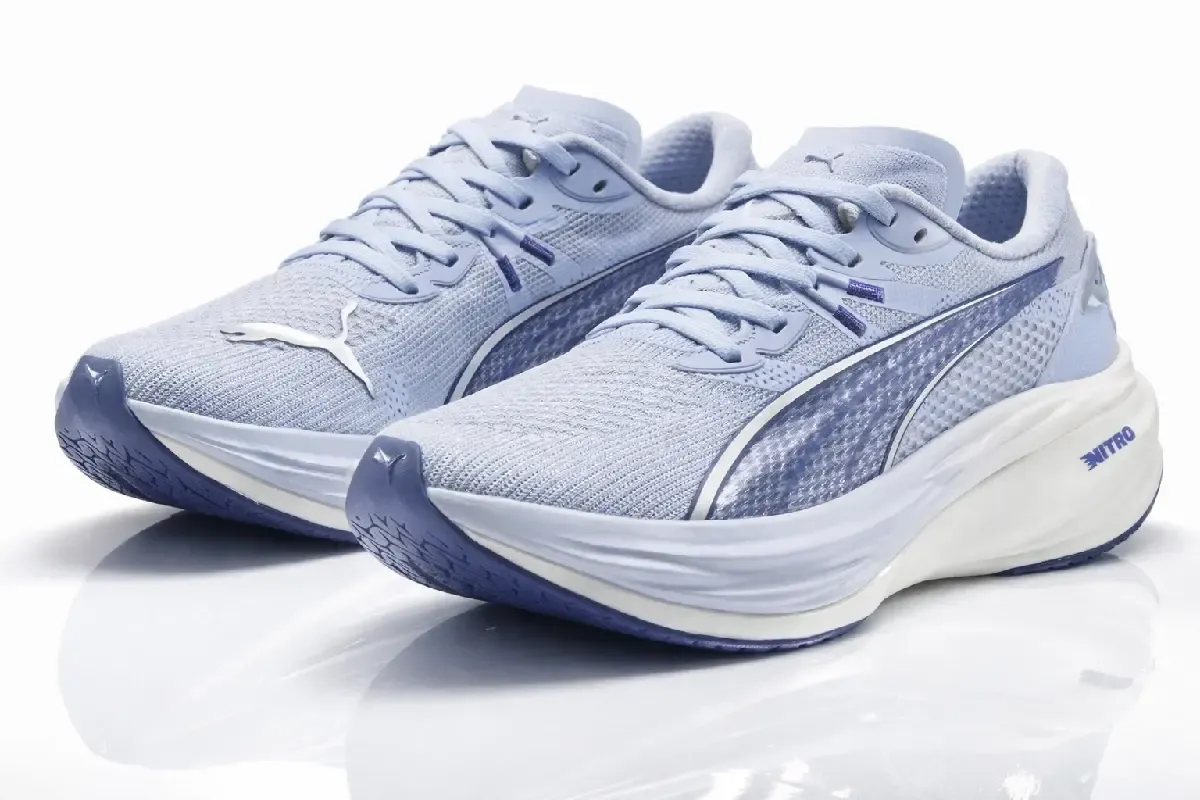
Puma Deviate Nitro 3 Review: A versatile carbon-plated running shoe perfect for speed training and gym workouts. Read our in-depth analysis.
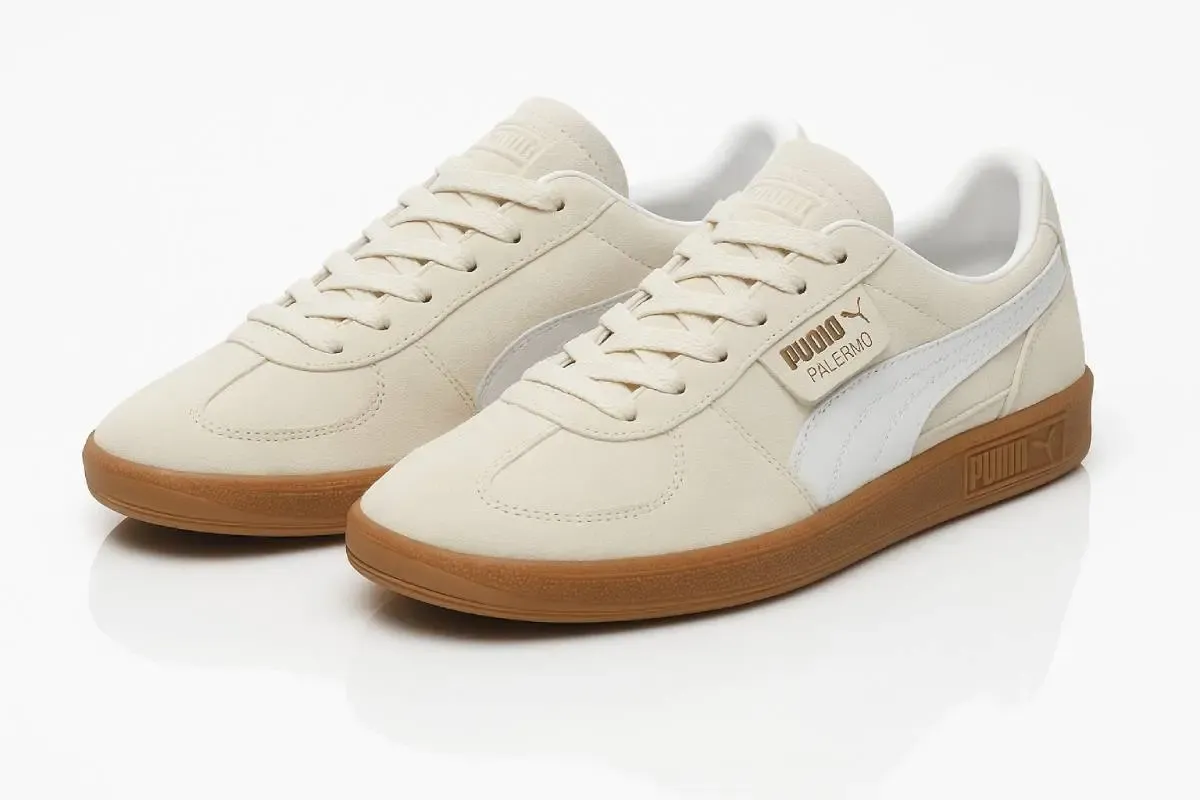
Puma Palermo Review
An in-depth review of the Puma Palermo. We cover comfort, sizing, style, and durability to see if this trendy retro sneaker is worth your money.
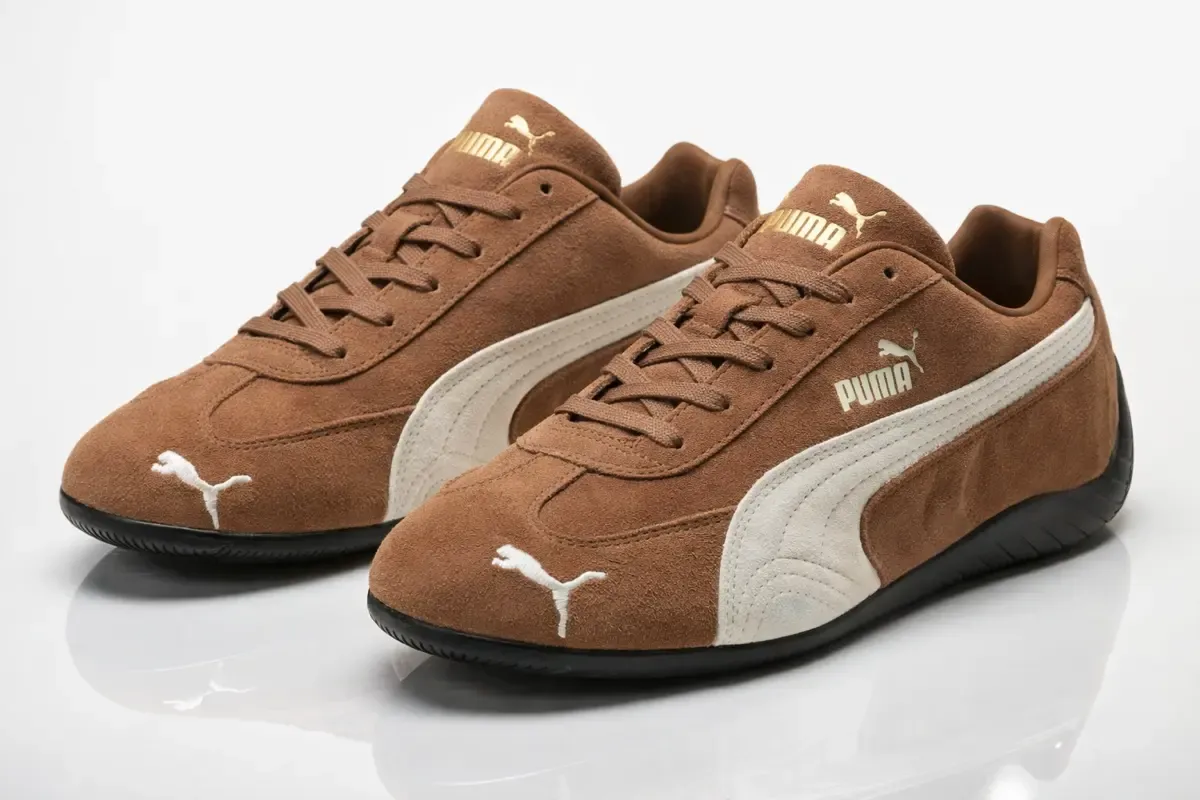
Puma Speedcat OG Review
Is the Puma Speedcat OG worth the hype? We analyze the fit, comfort, and F1 history of this trending ballet-style sneaker. Read the full verdict.
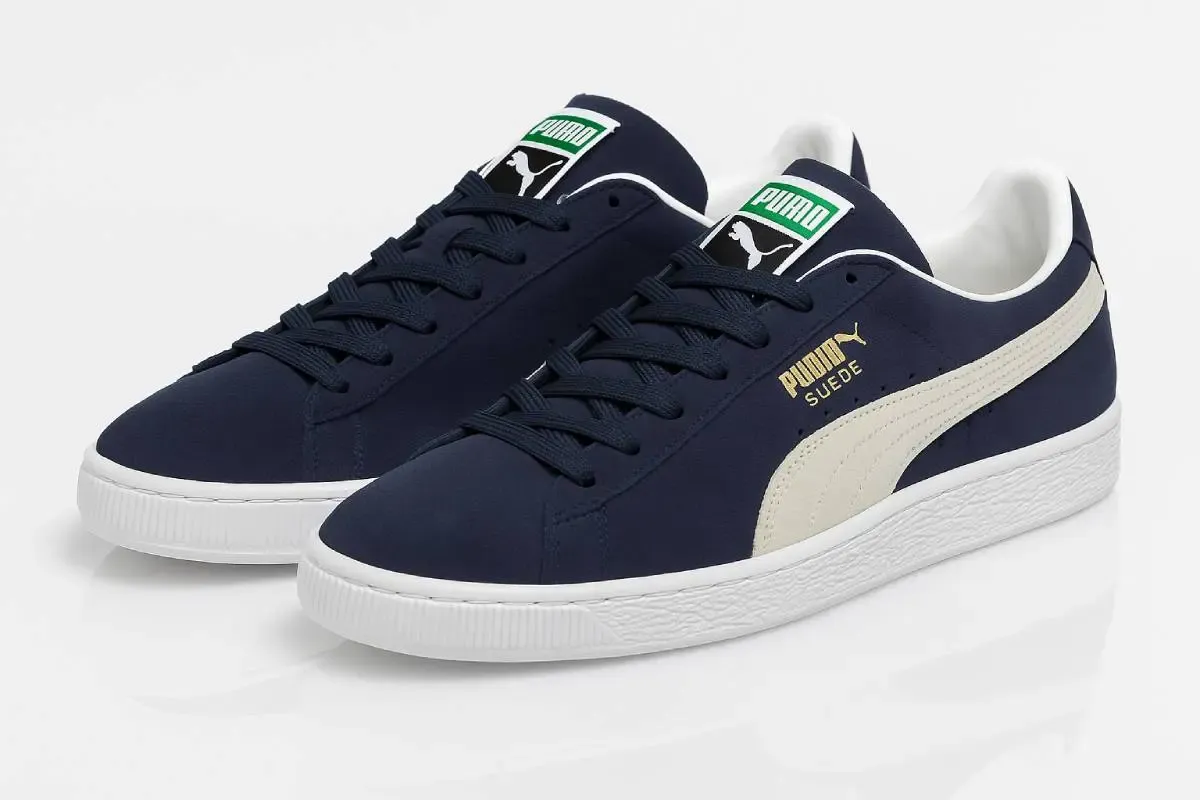
Puma Suede Classic Review
A comprehensive review of the iconic Puma Suede Classic. We break down the style, comfort, fit, and durability to help you decide if it's worth it.
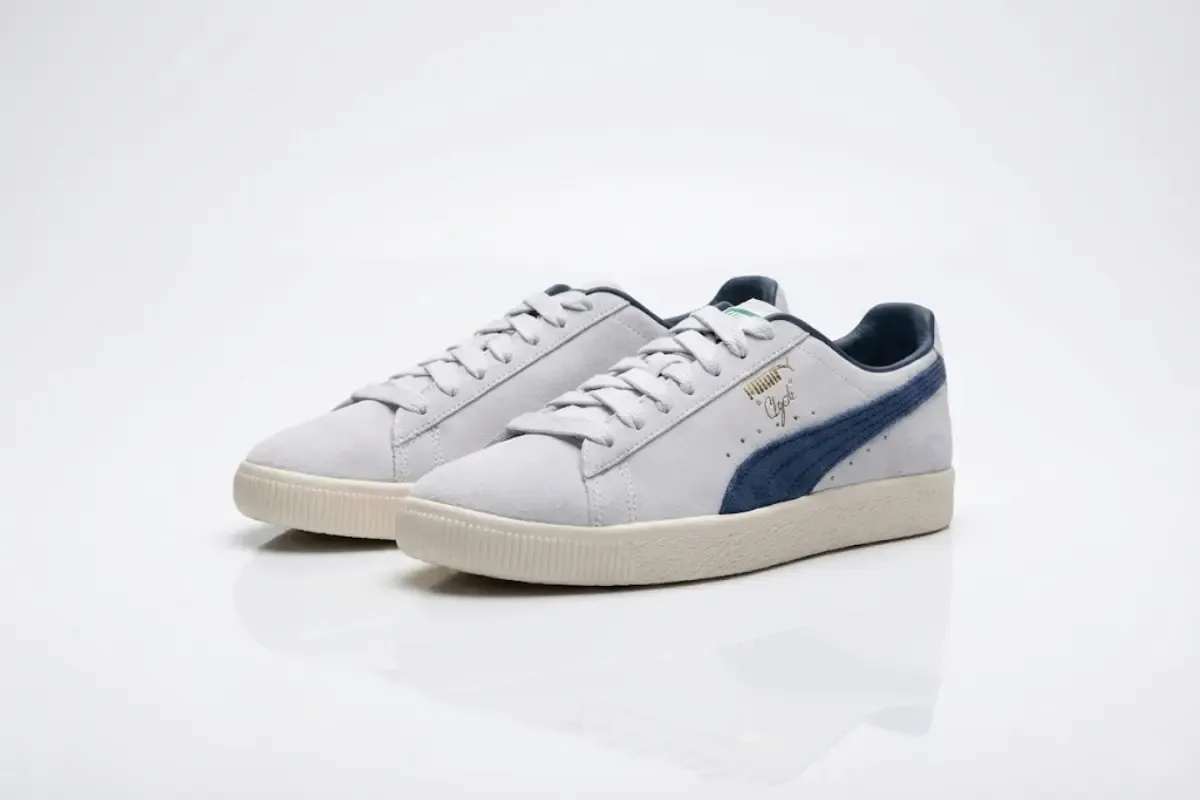
Puma Clyde Review
Puma Clyde Review: A detailed breakdown of the All-Pro Nitro and Premium Lifestyle models. Discover sizing, pros, cons, and performance stats.