
Highlights
Positive
- The BOOST midsole technology remains the defining comfort feature of the Ultraboost 1.0, with customers consistently praising its responsive cushioning.
- The clean, modern silhouette transitions seamlessly between athletic and casual contexts, with many users appreciating how it complements various outfits.
Negative
- The most common fit complaint centers around the tight collar opening and pressure across the top of the foot.
User Insights
From 3475 verified reviews
Rating Distribution
Feature Feedback
% positiveExperience Level
Ready to experience the Adidas Ultraboost 1.0 Shoes Review?
Get yours today with fast shipping from Amazon
It is rare that a sneaker genuinely changes the trajectory of an entire industry, but if we are being honest, the Adidas Ultraboost 1.0 did exactly that when it dropped back in February 2015. Initially marketed as the "Greatest Running Shoe Ever," it arguably failed to hold that specific title for long against the rise of super-shoes, yet it succeeded in doing something much more impressive: it became the gold standard for lifestyle comfort. Even now, with the release of the "10th Anniversary" edition in February 2025, the silhouette remains a dominant force in sneaker culture.
As a footwear journalist who has worn just about every iteration of foam under the sun, I find myself coming back to the 1.0 not for marathons, but for the marathon that is daily life. It represents a pivotal moment in Adidas history, evolving rapidly from a high-performance trainer into a casual wear juggernaut. Whether you are looking at the "Core Black" or the iconic "Triple White," the question remains: does a decade-old technology still justify the premium price tag in 2025? Let’s dive in.
Quick Take
Overall Rating: 4.3/5
Best For: Casual wear, daily walking, urban commuting, and travel.
Key Strengths: Exceptional "cloud-like" comfort, breathable Primeknit upper, versatile style, and durable Continental outsole.
Notable Limitations: Substantially heavier than modern running shoes, expensive retail price, and lack of energy return for serious runners.
Visual Snapshot Summary
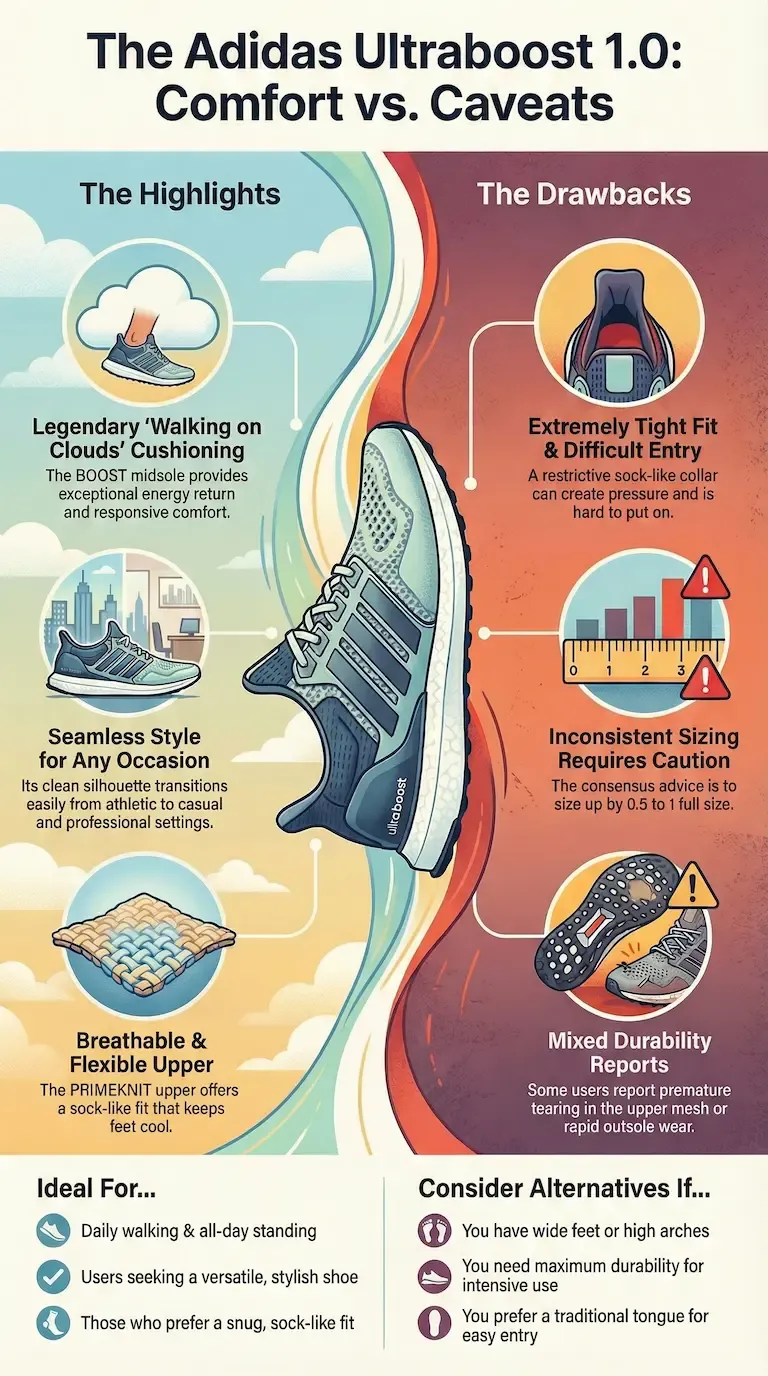
What Makes Adidas Ultraboost 1.0 Stand Out?
You know what? It’s arguably the synergy of the components that makes this shoe iconic, rather than just one single feature. When the Ultraboost 1.0 launched, it combined three specific technologies that had never really played together this well before: the Primeknit upper, the full-length Boost midsole, and the Torsion System.
The defining feature, without a doubt, is that Boost midsole. Developed with BASF, those thousands of expanded thermoplastic polyurethane (TPU) energy capsules created a sensation that was radically different from the stiff EVA foams we were used to. It offered a "springy" and responsive feel that felt alive underfoot. Then you have the Primeknit. This was one of the first times we saw a digitally knitted upper that truly functioned like a second skin, inspired—believe it or not—by a knitted glove. It used ARAMIS motion capture technology to ensure the knit supported the foot exactly where needed, expanding and contracting with your stride.
When you combine that with the external heel counter and the plastic midfoot cage, you get a lockdown that feels secure yet unrestrictive. While newer foams are lighter and bouncier, the 1.0 stands out because it mastered the art of walking comfort before "lifestyle runner" was even a popular category.
One customer summed it up perfectly:
"Comfort embodied... 10/10 comfort, perfect everyday shoe."
Real Customer Experiences
To get a real sense of how this shoe performs in the wild, I’ve combed through thousands of user reviews across multiple platforms. Here is the general consensus:
- The "Walking on Clouds" Effect: The overwhelming majority of users cite the Boost midsole as the primary reason for purchase, frequently describing the experience as "super cushiony" or having a "cloud-like feel". It is widely considered the most comfortable walking shoe on the market.
- Style Over Speed: While some users still take these for light jogs, the sentiment has shifted. Users love it as a "fashionable-and-cozy everyday sneaker" that pairs with almost any outfit, rather than a dedicated track shoe.
- The Weight Penalty: A recurring complaint, especially from those who have tried newer shoes, is the weight. Users note it feels "substantially heavier than the average running shoe," which makes it feel "sloppy" for fast running.
What Buyers Are Saying:
"The most comfortable running shoes I have ever worn... feels like a sock hugging your foot."
"Please for all thats good and holy dont use these as running shoes."
Design and Build Quality
Let me explain the architecture of this shoe, because the build quality is where you really start to understand the price point.
The Upper The upper is constructed from Adidas Primeknit, a seamless, one-piece textile that is digitally knitted. Unlike traditional mesh that is cut and sewn, this is a single unit designed to wrap the foot. The 1.0 specific pattern is distinct—it features a defined outline around the toe box and those arrow-like ventilation holes that point forward. It is visually sharper than later models. You also have the iconic plastic "cage" on the midfoot which houses the laces. While some purists find the cage a bit rigid, it provides necessary structure to the soft knit.
The Midsole This is the heart of the shoe: a full-length Boost foam midsole. It creates a stark white (usually) slab of cushioning that is 100% visible. The stack height is generous, with a 10mm drop (approx. 22mm heel / 12mm forefoot), which favors heel strikers. The foam is soft, allowing it to splay out upon impact.
The Outsole Here is the thing about the outsole: early versions of the 1.0 had these little rubber nubs that wore down notoriously fast. However, almost all modern re-releases (often called Ultraboost DNA) now feature the Continental™ Rubber outsole. This is a massive upgrade. The Stretchweb design allows the sole to flex with the Boost, and the Continental rubber offers incredible traction, even on wet urban surfaces.
Weight and Tech We have to talk about the weight. At approximately 11.3 oz (320g) for a standard men's size, it is heavy by modern standards. The density of the TPU pellets adds up. Buried inside that foam is the Torsion System, a thermoplastic shank that bridges the heel and forefoot to prevent your foot from twisting, adding a "disguised arch support".
Comfort and Fit
If there is one section of this review you pay attention to, make it this one, because sizing the Ultraboost 1.0 can be a little tricky.
Sizing Advice The general consensus is that the Ultraboost 1.0 fits True to Size (TTS) for most people. However, and this is a big "however," the fit is what I would call "aggressive." The Primeknit is designed to hug the foot like a sock.
If you have wide feet, you absolutely need to go up a half size. I have heard countless stories of people sticking to their measured size and finding the midfoot cage too constricting or the tongue area too tight. The upper is narrower than average at the ball of the foot (around 95.9mm), so that extra half size gives your foot room to breathe.
The "Hug" and Break-in Honestly, the first time you put them on, they might feel a little snug. This is normal. The Primeknit has engineered stretch zones and will adapt to your foot shape after a few wears. It doesn't require a painful break-in period, but give it "a couple of runs" or long walks to customize to your foot. Once it settles, it provides a lockdown that prevents your foot from sliding around, which is why people describe it as "sock-like comfort".
Breathability The knit structure of the 1.0 is exceptionally breathable. The ventilation holes in the toe box aren't just for show; they actually work to mitigate foot sweat, making this a great option for warmer climates or stuffy offices.
Style and Versatility
The transition of the Ultraboost 1.0 from a performance runner to a style icon is fascinating. It really kicked into high gear when Kanye West started rocking the "Triple White" and OG colorways back in 2015, effectively bridging the gap between high-performance gear and high-fashion streetwear.
Aesthetically, the shoe is sleek. The contrast between the organic, soft texture of the knit and the industrial look of the plastic cage and styrofoam-like midsole just works. It is less bulky than the chunky "dad shoes" of recent trends but has enough volume to anchor an outfit.
Ideal Scenarios:
- The "Airport Fit": This is arguably the best travel shoe in existence. Easy to slip on and off (especially once broken in), and comfortable enough for sprinting to Gate B42.
- Office Casual: If your workplace allows sneakers, a clean black or grey pair looks sharp with chinos or dark denim.
- Athleisure: Pair them with tapered joggers or pin-rolled jeans. The silhouette shines when the ankle is visible.
You know, the "Triple White" is still a summer staple, but be warned: that Primeknit attracts dirt, and the Boost midsole can yellow over time.
Quality and Durability
When you are dropping nearly $200 on a sneaker, you want it to last. The Ultraboost 1.0 generally holds up well, but it has its quirks.
The Good: The Boost midsole is incredibly resilient. Unlike EVA foam that compresses and stays flat effectively "dying" after a few months, Boost bounces back. You can expect the cushioning to maintain its feel for hundreds of miles. Furthermore, the introduction of the Continental™ Rubber outsole has solved the early wear issues. This rubber is tough. I’ve seen pairs with over 500 miles where the outsole still has plenty of tread life.
The Bad: The Achilles heel of this shoe is the upper. While comfortable, the Primeknit is a fabric. If you use these for sports with lateral movement (like tennis or basketball), you will rip through the sides. It is not built for lateral containment. Also, the plastic cage is prone to scuffing, which can make the shoe look beat up even if the structural integrity is fine.
Maintenance Note: The Boost foam is notoriously difficult to clean once it gets dirty. It has a craggy texture that traps dirt. It also tends to yellow due to oxidation. You can use an oil-based white marker to refresh it, but it’s a bit of a hassle.
Decision Matrix
To help you decide if this fits your specific rotation, I’ve broken down its performance across a few key scenarios.
| Scenario ↓ / Criterion → | Comfort | Breathability | Rain/Grip | Style |
|---|---|---|---|---|
| Daily Urban | ✓ | ✓ | ○ | ✓ |
| Office Casual | ✓ | ✓ | ○ | ✓ |
| Light Sport/Gym | ✓ | ✓ | N/A | ○ |
Legend: ✓ = Good ○ = Average ✕ = Poor
Who Should Buy
Perfect For
- The City Commuter: If you walk miles on concrete every day and your feet hurt by 5 PM, the impact protection of Boost is exactly what you need.
- The Wide-Footed Walker: Paradoxically, despite running narrow, the stretchy upper accommodates bunions and wide feet better than stiff leather sneakers—just remember to size up.
- The Sneaker Historian: If you appreciate the "Kanye era" aesthetic and want a shoe that defined the mid-2010s, this is a wardrobe essential.
- The Traveler: Perfect for long flights and sightseeing tours where you need one shoe to do it all.
- Daily training runners seeking comfort
Consider Alternatives If
- The Marathon Trainer: Do not buy this for your 20-mile long runs. It is too heavy and lacks the energy return of modern super foams like ZoomX or Lightstrike Pro.
- The Forefoot Striker: With a steep 10mm drop and less cushioning in the front compared to the heel, this shoe can feel jarring if you land on your toes.
- The Stability Seeker: If you overpronate significantly, the soft Boost foam might feel too unstable. You need a shoe with medial posts or guide rails, which this lacks.
- The Lateral Mover: If you play tennis or do HIIT workouts with side-to-side jumping, the knitted upper offers zero support. You will roll your ankle.
Final Verdict
The Adidas Ultraboost 1.0 occupies a unique space in the footwear world. It is no longer the pinnacle of running performance it claimed to be in 2015; the sport has simply moved on to lighter, faster technologies. However, as a daily driver for life outside of running, it remains virtually unbeaten.
The combination of the timeless 1.0 Primeknit pattern and the reliable squish of the Boost midsole creates a sneaker that feels like a slipper but looks like a piece of modern art. It is heavy, yes, and it can be expensive at full retail. But if you can snag a pair on sale, you are getting one of the most comfortable, versatile, and durable sneakers ever made. It’s a classic for a reason.
As an Amazon Associate we earn from qualifying purchases. This helps support our site so we can keep bringing you the best content!